
NEWS
Gottheimer’s AI LABS Act Enters an Already Crowded Field
The bipartisan AI LABS Act would fund dedicated K-12 labs, arriving after White House orders, union age gates, and free high-school chatbots already in place.

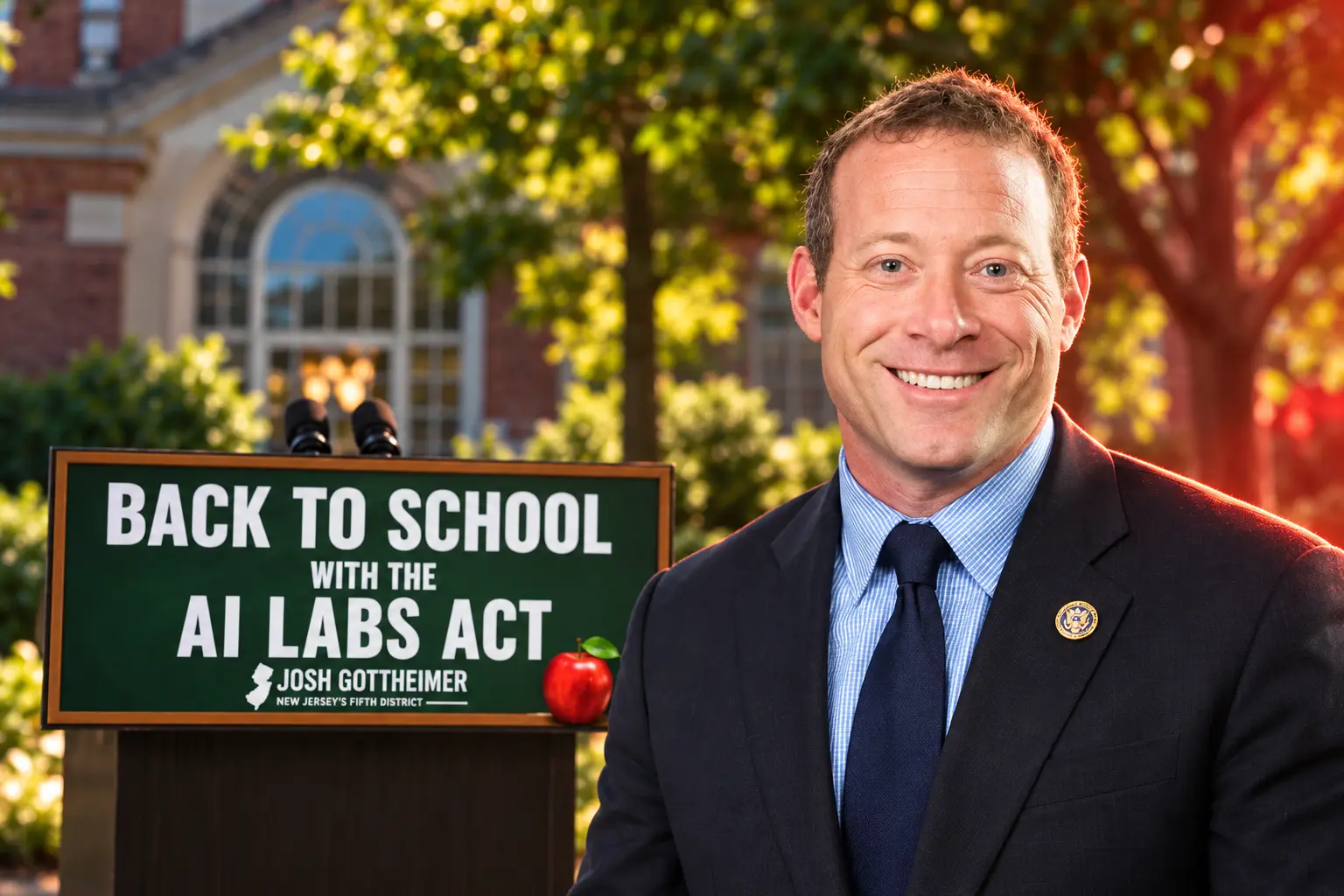
Rep. Josh Gottheimer on Sept. 4 proposed a federal grant to put dedicated AI labs in K-12 schools, with Rep. Jay Obernolte as co-lead. The New Jersey Democrat unveiled the AI LABS Act at George Washington Middle School in Ridgewood, N.J., and compared the rooms to the computer labs that became standard in the 1980s and 1990s.
The rooms are the sellable object. They would open inside rules already written by a White House task force, an Education Department grant priority, a House science bill that cleared committee, free high-school chatbots, and teacher-union age gates on student-facing tools.
The Bill Funds Rooms and a Study of Who Gets Them
Gottheimer, co-chair of the House Commission on Artificial Intelligence and the Innovation Economy, put the labs at the center of a bipartisan back-to-school AI agenda that also covers classroom phones, state curriculum help, and rural broadband. Obernolte, a California Republican, is the co-lead. In a press release he said AI can be a powerful tool and that it can never replace the fundamentals.
I don’t want to raise a generation of children who can prompt a chatbot, but can’t write a paragraph on their own, or think through what question to ask the chatbot. I want to raise a generation of children who can use it to genuinely improve their work, because they understand how to use it and know its limits.
Rep. Josh Gottheimer, George Washington Middle School, Ridgewood, N.J.
He used the same “false choice” line again on Sept. 8, in a video from his official account, still asking for tools, teacher training, and a head start.
Our students need to learn how to think, solve problems, ask questions, and understand the material for themselves, not through a chatbot. We should use AI to strengthen those skills – not use it as a shortcut around them.
That’s the whole idea behind the AI LABS Act. Give our… pic.twitter.com/M3E9YfjjM0
— Rep Josh Gottheimer (@RepJoshG) September 8, 2026
WHAT THE AI LABS ACT DIRECTS
- The grant: The Education Department would create a federal program to help K-12 public schools stand up dedicated AI labs with real curricula.
- Teacher training: The same money would prepare educators to teach how the tools work and how to judge what they produce.
- The study: The department would track who receives the resources and how the labs are used.
- Later spending: That review would feed recommendations on future federal investment in AI education.
- Who writes the lessons: Gottheimer said the bill builds on American Federation of Teachers and National Education Association calls for dedicated AI curricula directed and supervised by educators.
At Ridgewood he argued that AI firms now hire philosophy and history graduates, not only computer science majors, because they want people who can think. He said the trades want the same habit on the shop floor: how to use the tools, how to question them, and how to know when not to trust them.
An Executive Order Already Put AI in Teacher Grants
The labs would not be the first federal push to put AI in K-12. President Donald Trump on April 23, 2025, signed an executive order on AI education that created a White House Task Force on Artificial Intelligence Education, chaired by the director of the Office of Science and Technology Policy, and ordered agencies to court industry partners for K-12 materials.
That order told the education secretary to favor AI in discretionary teacher-training grants under the Elementary and Secondary Education Act and Title II of the Higher Education Act, including professional development so teachers can work AI into every subject. It also told the National Science Foundation to prioritize research on AI in class, and it set up a Presidential Artificial Intelligence Challenge for students and teachers.
On April 13, 2026, the department went further and published an Education Department AI grant priority for discretionary programs. That priority covers AI literacy, spotting AI-made falsehoods, and age-appropriate training that keeps student safety in view. On Aug. 20, 2026, Assistant Secretary of Elementary and Secondary Education Kirsten Baesler, in department guidance, backed state phone limits and said instructional tools should be judged by whether they help students learn.
HOW AI REACHED THE K-12 GRANT QUEUE
- April 23, 2025: Trump signs Executive Order 14277 and stands up the White House AI education task force.
- Sept. 9, 2025: The White House posts industry pledges, including Google’s $1 billion education commitment and free Gemini for Education for every American high school.
- Sept. 26, 2025: Reps. Tom Kean Jr. and Gabe Amo introduce the LIFT AI Act for K-12 literacy work at NSF.
- July 2025: The AFT announces a National Academy for AI Instruction with Microsoft, OpenAI, and Anthropic, a $23 million effort aimed at more than 400,000 teachers by 2030.
- April 13, 2026: The Education Department finalizes a supplemental priority on advancing AI in education.
- June 25, 2026: House Science orders the LIFT AI Act reported by a 34-1 vote.
- Sept. 4, 2026: Gottheimer and Obernolte announce the AI LABS Act in Ridgewood.
A lab grant can still add a room and a trained adult. It does not open empty ground. High schools can already get a major chatbot at no charge, and teacher training is already being sold as a national academy and as an Education Department scoring preference.
The Guardrails Came From the Teacher Unions
Gottheimer said his bill follows union advice that educators, not vendors, should run AI lessons. That advice is stricter than a new computer room.
AFT President Randi Weingarten on May 27, 2026, at the National Press Club, released a 10-point plan for AI-era schools under the banner “devices down, eyes up, hands-on.” The plan bars screens for pre-K through second grade except for special needs, bars student-facing AI in elementary school, and calls for a ban on social companion chatbots until at least age 16. All other student-facing AI, including digital literacy work, would sit under educator supervision.
I’m not calling for an AI ban or a Chromebook bonfire. What I am calling for is getting the balance right to harness the benefits of technology while mitigating the harms. I’m wary of the dangers of AI, but it is here to stay.
Randi Weingarten, President, American Federation of Teachers, National Press Club
The AFT cited a Pew Research Center study finding that about 54 percent of teenagers use AI for homework. Weingarten also asked for a “gold standard” on safety and privacy, an independent research consortium, more state and federal school funding, and a “tech tax” on large firms.
In the same back-to-school window, New York City Mayor Mamdani announced a one-year moratorium on student-facing generative AI from 2-K through eighth grade. Pilots that remain would run at most 45 minutes a week under a teacher, and the city said it would shut off AI features in more than 38 programs that fail the new tests. A federal lab grant that treats K-12 as one band will hit that wall in elementary grades unless the labs are built as teacher rooms, not chatbot stations.
Lock the Phones, Then Open the Lab
Gottheimer did not pitch the labs alone. He used the Ridgewood visit to back classroom phone limits and the bipartisan UNPLUGGED Act from Reps. Eugene Vindman and Jen Kiggans, which would help states and districts pay for lockers, lock boxes, and magnetic pouches, with exceptions for medical needs, disabilities, and English learners.
New Jersey is already ahead of that federal bill. A state law signed Jan. 8, 2026, requires each board of education to adopt a bell-to-bell policy against student use of internet-enabled devices. Gottheimer’s office said public districts in Bergen, Passaic, and Sussex counties, including 11 in the 5th Congressional District, received Phone-Free Schools Grant Program money this school year to carry those limits out.
A Federal Communications Commission notice this year counted at least 11 states with full or partial school phone or social-media limits in early 2025, and over 30 states by fall 2025. The political package is consistent even if the hardware is not: lock the personal screen, then argue that a supervised lab is a different kind of machine. Districts will still have to explain why a school PC running a model is instruction and a phone running the same model is a distraction.
Who Gets an AI Lab Without a Connection?
The clause that will matter after the photo op is the study of who receives the labs. Gottheimer said he is sending a letter to the Federal Communications Commission and the National Telecommunications and Information Administration asking both to put rural and underserved school districts first for broadband, “so the benefits of AI are not concentrated in the wealthiest, most connected communities.”
A dedicated lab still needs a pipe and power. Putting workstations in Ridgewood does not move fiber into a district that cannot keep a video lesson alive, and it does not shrink the electricity bill that already sits behind every large model. The letter admits that gap; it does not fund the labs, and it is not the bill.
WHAT WE KNOW
- The vehicle: A proposed Education Department grant for dedicated K-12 AI labs, teacher training, and a distribution study, announced Sept. 4, 2026, with Obernolte.
- The local wrap: Phone limits, a push for state AI coursework, and a broadband letter to the FCC and NTIA travel with the same agenda.
- The union overlay: AFT policy already rejects student-facing AI in elementary school and companion chatbots until age 16.
WHAT IS UNCONFIRMED
- The price: No dollar figure, authorization level, or matching-fund rule has been posted with the announcement.
- The bill number: No public H.R. file or committee referral for the AI LABS Act was on Congress.gov as of the Sept. 8 video.
- The elementary question: The announcement does not say whether a K-12 lab grant would respect the AFT bar on student-facing AI below middle school, or how it would sit beside free Gemini in high schools.
Until those answers exist, the study clause is doing the work the computer-lab comparison cannot. The 1980s rooms did not close the gap between wired suburbs and everyone else. A new lab program that cannot say who qualifies, what connectivity they need, and which grades may touch a model will repeat that map in software.
House Science Already Advanced a 34-1 Literacy Bill
Gottheimer is not starting from zero on literacy either. He is a cosponsor of the LIFT AI Act, H.R. 5584, led by Kean, a fellow New Jersey Republican, and Amo of Rhode Island. House Science on June 25, 2026, ordered that bill reported 34-1. It would create NSF grants for K-12 AI literacy curriculum, evaluation tools, and professional learning, and Amo’s office lists endorsements from the AFT, Google, and OpenAI.
THE SCHOOL AI TRACKS NOW IN PLAY
| Track | Who runs it | What it buys | Status |
|---|---|---|---|
| AI LABS Act | Education Department | Dedicated K-12 labs, teacher training, a study of who gets the money | Announced Sept. 4, 2026; no posted funding |
| LIFT AI Act (H.R. 5584) | National Science Foundation | Curriculum research, hands-on tools, educator professional learning | Ordered reported 34-1 on June 25, 2026 |
| Executive Order 14277 | White House task force, Education, NSF, Labor | Teacher-grant preference, industry partnerships, a presidential challenge | Signed April 23, 2025 |
| AFT National Academy for AI Instruction | AFT with Microsoft, OpenAI, Anthropic | Teacher training at scale, $23 million, more than 400,000 teachers by 2030 | Announced July 2025 |
| Gemini for Education | Google, under White House pledges | Free high-school access to Gemini 2.5 Pro and related classroom tools | Pledged Sept. 9, 2025 |
LIFT spends through NSF and the Science Committee. The labs bill would spend through Education. One writes lessons and tests. The other writes a room. Schools can use both, and they can also open the free chatbot on a cart in the hallway. The open question is which of those three a principal will staff when the schedule already lost a period to phone collection.
The Bill Still Has No Price Tag
Four days after Ridgewood, Gottheimer was still selling the labs as the way off a false choice, and the proposal still had no dollar figure attached. Committee jurisdiction, matching rules, and whether an elementary lab is even allowed under the union terms he cited remain unwritten in public.
The room can still be the right object if the grant pays for a teacher who can show how a model fails, in a district that can keep the lights on. Without a number, a connectivity test, and a grade-by-grade rule, it is a computer lab with a new sign, waiting on the same pipe the broadband letter is asking someone else to build.

Nesta Finds a Baby Blind Spot in Scotland’s GIRFEC Promise

FDA Closes Cyclospora Lettuce Probe Without Proving How

Pixel Watch 5 Discount Erases Google’s $50 Launch Hike

Pokémon GO Halloween 2026 Locks Candy Behind a Pass

ARX Robotics and Roboneers Tie Ukraine Combat to Western Fleets

Where Can I Cash a Comcheck – What Are My Options?

The Yen Rally Was Funded by a Record Reserve Sale

OpenAI Turns ChatGPT Into a $1 Billion Ad Auction

Arm Bets Compute Subsystems Will Reach Physical AI

Coremail Pitches AI-Native Email Security at LEAP 2026
-
 LIFESTYLE3 years ago
Where Can I Cash a Comcheck – What Are My Options?
-
 BUSINESS1 month ago
The Yen Rally Was Funded by a Record Reserve Sale
-
 BUSINESS2 months ago
OpenAI Turns ChatGPT Into a $1 Billion Ad Auction
-
 NEWS1 month ago
Coremail Pitches AI-Native Email Security at LEAP 2026
-
 NEWS1 month ago
Arm Bets Compute Subsystems Will Reach Physical AI
-

 BUSINESS1 month ago
Ostrich Farms Rebuild Around a Tick-Bite Meat Allergy
-

 TECHNOLOGY3 years ago
How Many Cards in a Uno Deck – What’s the Exact Number?
-

 LIFESTYLE3 years ago
Things to Do with a Teenager Near Me – What Are Some Fun Ideas?