
NEWS
FDA Closes Cyclospora Lettuce Probe Without Proving How
FDA ended the Taylor Farms iceberg lettuce cyclospora outbreak at 12,883 cases without proving how contamination happened, as Mexico rejected the product link.

The FDA closed its cyclospora iceberg lettuce investigation on October 2 after 12,883 laboratory-confirmed illnesses, still unable to say how the parasite reached the crop. The Centers for Disease Control and Prevention had already declared the outbreak over on September 11. Two people died in Michigan, and 570 people were admitted to hospital across 21 states.
Mexico’s health ministry answered the next day that environmental finds do not prove Mexican produce was the source. Taylor Farms de Mexico, the processor named in the traceback, says the plant is still shut and that the wastewater sample came in after the lines had already stopped.
Inspectors Found the Parasite in a Waste Tank and a Ditch
Traceback identified several farms and a processing plant in central Mexico that supplied recalled lettuce distributed in the United States by Taylor Fresh Foods. Working with Mexican officials, FDA teams sampled water, soil, sediment, and iceberg lettuce at multiple growers and at the plant.
Of those samples, two samples tested positive for Cyclospora. One came from a tank that held outgoing wastewater at the Taylor Farms de Mexico processing facility. The second came from a drainage ditch at an iceberg lettuce grower named in the traceback. The agency said genotyping on both environmental samples is finished and that it is still comparing those results with samples from patients.
While there is currently not enough evidence to conclusively determine how contamination occurred in this outbreak, the positive samples show that Cyclospora was present in the environment where lettuce was grown and processed.
U.S. Food and Drug Administration, outbreak close-out, October 2, 2026
That sentence is the whole close-out in miniature. The agency still ties the illnesses to recalled shredded iceberg from Taylor Farms de Mexico through patient interviews and a traceback that converged on one supplier. It does not claim the two water finds prove the route onto the leaf.
THE OUTBREAK CLOCK
- June 14, 2026: First illness onset linked to the outbreak, per CDC.
- July 16, 2026: FDA and CDC announce a multistate investigation of cyclospora illnesses tied to iceberg lettuce.
- July 17, 2026: Taylor Farms de Mexico starts a voluntary recall of iceberg lettuce sourced from central Mexico.
- July 18 to 20, 2026: Cofepris inspects the plant and collects lettuce and water samples.
- August 20, 2026: FDA announces it has started onsite inspections and sampling at lettuce growers in Mexico.
- September 11, 2026: CDC declares the outbreak over.
- October 2, 2026: FDA releases the two environmental positives and closes the outbreak investigation.
The recalled bags carried best-by dates through August 3, 2026, and the agency says that lettuce is no longer in stores or restaurants. Recalled product was also sold to consumers in Mexico, according to customer records the firm gave FDA.
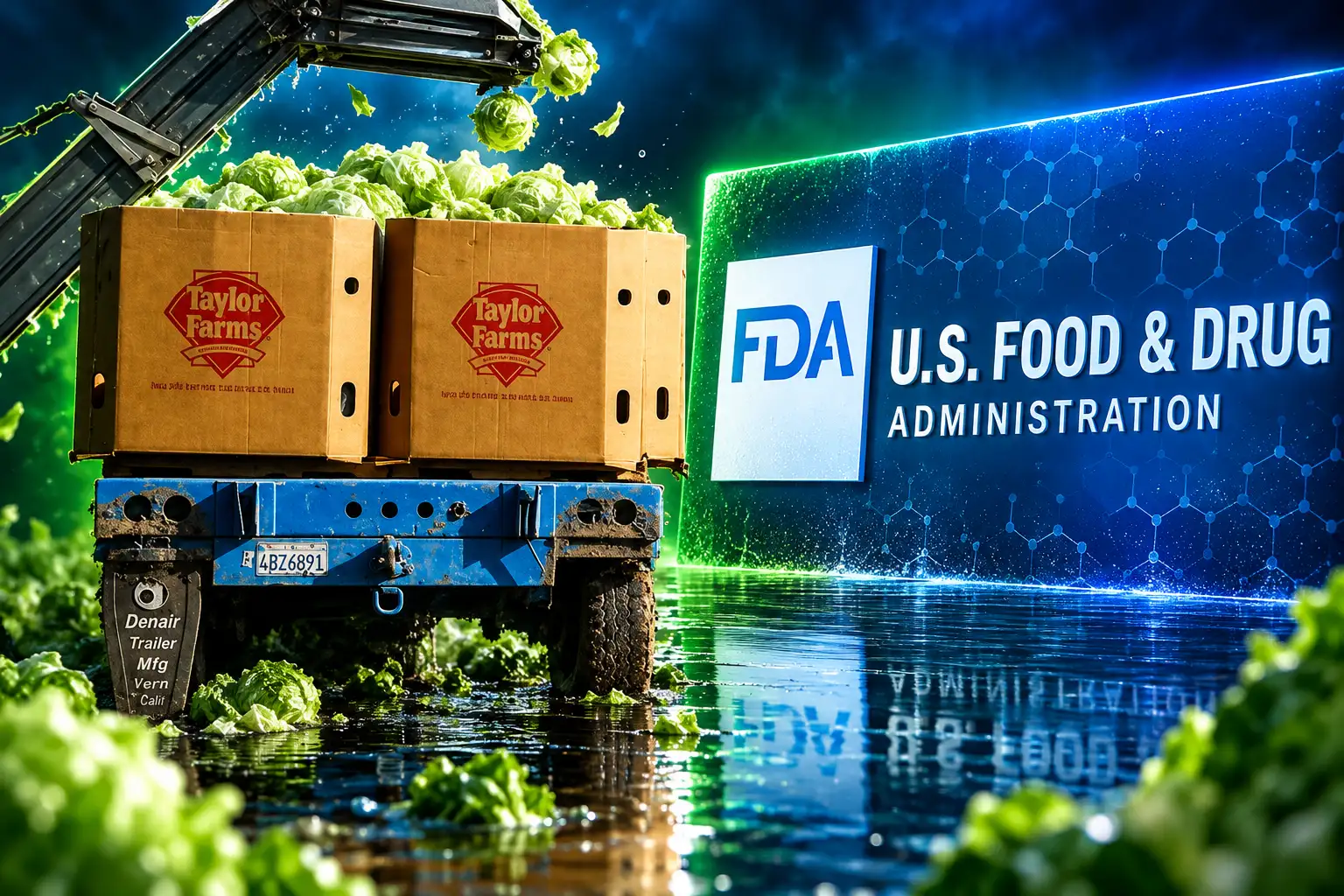
Taylor Farms Says That Sample Came Weeks After the Lines Stopped
On October 2 the company posted a statement on its site as FDA closed the file. The central Mexico facility remains closed, it said, while a research team works on safety steps from the field to the plant. The independent grower tied to the ditch sample is no longer in its supplier program.
The wastewater finding is the part the company wants read with a clock. Taylor Farms said the sample FDA cited came from discharged waste and sewer water outside the processing facility, taken more than three weeks after production was suspended, and that wastewater clears the site within 24 hours. It repeated FDA’s own line that there is not enough evidence to say how contamination occurred, or how those samples relate to genotyping of clinical specimens.
That timing argument does not erase the epidemiologic file. CDC said iceberg lettuce from Taylor Farms de Mexico, a central Mexico processor, was contaminated with cyclospora and made people sick. Most of those illnesses began before the July 17 recall. At the peak, before the recall, more than 1,000 infections occurred in a single day. In August the daily average fell below two.
Taco Bell said it stopped using lettuce from Taylor Farms de Mexico as of July 17. Recalled Marketside bags went to selected Walmart stores in 15 states. Foodservice shipments from June 29 through July 16 were confirmed in 31 states, with possible further movement beyond that list. The chain restaurants were customers on a shared shred, not the farms.
Mexico’s Health Ministry Still Will Not Call the Lettuce the Source
On October 3, Mexico’s Secretariat of Health and the Federal Commission for Protection against Sanitary Risks (Cofepris) answered the U.S. close-out. They noted FDA’s two environmental positives, then drew a harder line than Washington did: environmental findings, they said, do not by themselves prove that farm products were the source of contamination.
Cofepris said its National Reference Laboratory had already tested raw material, finished iceberg, and water from the investigated plant and found them negative for Cyclospora cayetanensis in all 10 samples. In the ministry’s telling, the information available at the close of both investigations does not allow conclusive laboratory proof that Mexican products originated the outbreaks.
WHERE EXPERTS DISAGREE
- FDA and CDC: Patient interviews and traceback converge on shredded iceberg from Taylor Farms de Mexico; two environmental samples show the parasite was present where that lettuce was grown and processed.
- Cofepris and the Secretariat of Health: Product and water tests at the plant were negative, and a wastewater tank plus a ditch do not prove the heads themselves were the source.
- Taylor Farms: The plant is closed and the named grower is gone, but the wastewater sample arrived after the lines had been down and after wastewater would have cleared the site.
Guanajuato Governor Libia Dennise García took that dispute onto local ground on October 6 and 7. She said there are no firm findings linking the contamination to vegetables processed in the state and asked that Guanajuato’s farms not be branded for an outbreak FDA itself could not route onto the leaf. Doctor Mora, where the plant sits, is now defending an export crop as much as a company.
Doctor Mora Already Lived This Investigation in 2013
The unfinished “how” at this address is not new. In August 2013, FDA led an environmental assessment at Taylor Farms de Mexico in Doctor Mora, Guanajuato, with Mexican agencies and CDC, after traceback tied a foodservice salad mix from that plant to restaurant clusters in Iowa and Nebraska.
The assessment ran August 12 through 19, 2013, at the processing plant and at farms identified in that traceback. The team wrote that it did not identify any significant potential source of the outbreak pathogen or any significant potential route of contamination onto the firm’s salad products. Taylor Farms de Mexico had already stopped shipping salad mix and leafy greens from Mexico to the United States as of August 9, 2013.
Thirteen years later the same processor is in the file again, this time on shredded iceberg, with a much larger U.S. case count and with the parasite recovered from wastewater and a ditch. The 2013 paper closed without a named route. The 2026 paper closes the same way, only now the laboratory has something in the water.
DOCTOR MORA, 13 YEARS APART
| Item | 2013 assessment | 2026 close-out |
|---|---|---|
| Plant | Taylor Farms de Mexico, Doctor Mora, Guanajuato | Same processor, central Mexico |
| Product in the traceback | Foodservice salad mix | Shredded iceberg lettuce |
| What FDA reported finding | No significant source or route identified | Parasite in outgoing wastewater and a grower’s drainage ditch |
| How contamination happened | Not determined | Not determined |
| Plant status after the finding | Shipments had already been halted, then later resumed | Company said on October 2 the facility remains closed |
The comparison is ugly for anyone who wanted a finished root-cause story out of either summer. It is also the fact pattern the 2027 plan is being written on top of: a processor FDA already walked, a parasite that still does not yield a route, and a winter lettuce corridor that still runs through Guanajuato.
12,883 Illnesses Spread Across 21 States
CDC’s final food-safety alert put the outbreak at 12,883 illnesses reported from 21 states, with onset dates from June 14 through August 17, 2026. Virginia was the last state added. The 21 states with outbreak cases were Arkansas, Georgia, Iowa, Illinois, Indiana, Kansas, Kentucky, Massachusetts, Maine, Michigan, Missouri, Nebraska, New Hampshire, North Carolina, Ohio, Oklahoma, Pennsylvania, Tennessee, Texas, Virginia, and West Virginia.
Those figures are laboratory-confirmed cases only. CDC said the true number of sick people was likely higher, because some recover without medical care and are never tested. The tally also includes people who traveled to one of the 21 states but live elsewhere. Genotyping on patient samples showed the parasites that caused these illnesses were genetically related, which the agency treated as further evidence of a common source.
THE OUTBREAK TALLY
- Illnesses: 12,883 laboratory-confirmed cases in the iceberg outbreak.
- Hospital care: 570 people admitted during the outbreak.
- Deaths: 2, both reported in Michigan.
- Peak day: More than 1,000 infections in a single day before the July 17 recall.
The iceberg cluster sat inside a much larger cyclospora season. For cases with symptom onset from May 1 through August 31, 2026, CDC logged 19,883 laboratory-confirmed cases acquired in the United States, with 1,064 hospitalizations and the same 2 deaths. In the same window of 2025, CDC recorded 1,180 U.S. cases. The 570 outbreak admissions and the 1,064 season-wide admissions are different piles: one is this lettuce cluster, the other is every domestic laboratory-confirmed case CDC posted for the season.
It can take as long as six weeks after symptoms start for a case to be counted, CDC said, and because this season’s numbers were so high, older cases may still dribble in past that window. That lag is why the official count kept climbing after the bags were gone from the cooler.
What the FDA Plan Changes Before the Next Harvest
Closing the outbreak file did not close the work. During the week of September 8, senior FDA and Mexican public health and agricultural officials met under the existing U.S.-Mexico food-safety partnership. FDA also sent a letter to industry asking firms to work on cyclospora across the supply chain, and it says it will fold lessons from this outbreak into its Cyclospora Prevention, Response and Research Action Plan.
On the same day it posted the two positives, the agency listed short-term actions to mitigate risks for the 2027 growing and harvesting season. The list is prevention language, not a finding of cause. It is also where U.S. importers, not only Taylor Farms, pick up new weight: FDA says it will increase Foreign Supplier Verification Program inspections so that importers treat cyclospora as a hazard in their analysis of foreign suppliers.
FDA’S 10 ACTIONS BEFORE THE NEXT HARVEST
- Outbreak report: Publish a report on the investigation, possible contributing factors, and prevention advice.
- More sampling: Increase surveillance of produce historically tied to cyclospora, and of how that produce is grown.
- Rule outreach: Brief growers at home and abroad on the Produce Safety Rule, Preventive Controls, and the Food Traceability Rule.
- Mexico labs: Help build laboratory capacity in Mexico so cyclospora samples can be finished in-country faster.
- Weather data: Use other data sources, including weather, to watch environmental conditions that may move the parasite.
- Training: Work with Mexico’s agriculture ministry, Cofepris, and SENASICA on food-safety training for fresh produce.
- Expert panels: Convene panels on worker health and hygiene, water and wastewater monitoring, and gaps in growing and processing.
- One genotype method: Work with CDC toward a single, repeatable cyclospora genotyping standard.
- Importer checks: Increase FSVP inspections so importers include cyclospora in hazard analysis and supplier verification.
- Action plan: Update the longer-term Cyclospora Prevention, Response and Research Action Plan with lessons from this outbreak.
A plan like that can be read as seriousness. It can also be read as the substitute for the sentence FDA could not write: how the parasite got on the shreds that made 12,883 people sick. The plant in Doctor Mora is still closed, the named grower is out, and the genotype match between ditch, tank, and patients is unfinished. Guanajuato’s governor is already asking that the state’s fields not be treated as the verdict. The 2027 harvest will move anyway, through importer paperwork and a mitigation list, on a contamination route nobody has nailed down.
Frequently Asked Questions
What Is Cyclospora and How Does It Spread on Produce?
Cyclospora cayetanensis is a microscopic parasite that causes watery diarrhea, loss of appetite, stomach cramps, bloating, nausea, and fatigue, with symptoms that can last days to a month or longer and can relapse. It does not grow in food. People get it by swallowing the parasite, usually on fresh produce that picked up contamination from water or soil carrying human feces. The organism needs days to weeks in the environment to become infectious, and routine chemical washes, including chlorination, are unlikely to kill it.
Did the FDA Find Cyclospora in Taylor Farms Lettuce?
No lettuce sample from the Mexico inspections tested positive. The only product-positive FDA announced, a border sample on July 18, was withdrawn the next day as a false positive; Mexico said that lot was held at Laredo, Texas, and never entered the United States. The two confirmed positives were environmental: outgoing wastewater at the plant and sediment in a grower’s drainage ditch.
How Many People Were Sickened in the Iceberg Lettuce Outbreak?
CDC’s final outbreak count is 12,883 laboratory-confirmed illnesses, 570 hospitalizations, and 2 deaths in Michigan, with onsets from June 14 through August 17, 2026. The agency said some people who traveled into the 21 named states but live elsewhere are included, and that people who were never tested are not, so the real total is likely higher. It can take about six weeks after symptoms start for a case to be placed in the outbreak file.
Was Taylor Farms de Mexico Linked to Cyclospora Before This Outbreak?
Yes. In 2013, FDA traceback tied a foodservice salad mix from Taylor Farms de Mexico in Doctor Mora, Guanajuato, to restaurant clusters supplied to Olive Garden and Red Lobster. An FDA-led environmental assessment at the plant and five farms from August 12 to 19, 2013, did not identify a significant source of the parasite or a significant route onto the mix. The company had already halted U.S. shipments of salad mix and leafy greens from Mexico as of August 9, 2013.
What Did Mexico’s Cofepris Test at the Plant in July?
From July 18 to 20, Cofepris collected five whole iceberg heads and five samples of chopped, washed, and disinfected finished lettuce, plus four water samples. Real-time PCR at the National Reference Laboratory and the Guanajuato state lab was negative for Cyclospora cayetanensis; water samples were also negative for fecal coliforms and within national physicochemical limits. Mexico said irrigation at the operation is drip irrigation and that the plant’s water comes from its own certified wells.
What Does the Foreign Supplier Verification Program Change for Importers?
FSVP is the FDA rule that requires U.S. importers to verify that food from foreign suppliers meets the same safety standards expected of domestic producers, including a hazard analysis. In the 2027 cyclospora plan, FDA says it will run more of those importer inspections with cyclospora written into that analysis, so the next winter lettuce season is policed at the importer’s desk as well as at the farm.
Disclaimer: This article is news reporting on a closed foodborne-illness investigation and related public statements. It is for information only and is not medical advice, a diagnosis, or guidance on whether any food is safe to eat. Readers who have symptoms of cyclosporiasis, or who have questions about treatment, should speak with a licensed physician or other qualified clinician. Case counts, laboratory results, and the status of the Taylor Farms de Mexico plant reflect the FDA, CDC, Mexican health authorities, and company statements cited here and may change if agencies issue further updates.

Nesta Finds a Baby Blind Spot in Scotland’s GIRFEC Promise

FDA Closes Cyclospora Lettuce Probe Without Proving How

Pixel Watch 5 Discount Erases Google’s $50 Launch Hike

Pokémon GO Halloween 2026 Locks Candy Behind a Pass

The Browns Beat the Steelers and Lost Mason Graham

Where Can I Cash a Comcheck – What Are My Options?

Arm Bets Compute Subsystems Will Reach Physical AI

OpenAI Turns ChatGPT Into a $1 Billion Ad Auction

Coremail Pitches AI-Native Email Security at LEAP 2026

The Yen Rally Was Funded by a Record Reserve Sale
-
 LIFESTYLE3 years ago
Where Can I Cash a Comcheck – What Are My Options?
-
 NEWS1 month ago
Arm Bets Compute Subsystems Will Reach Physical AI
-
 BUSINESS1 month ago
OpenAI Turns ChatGPT Into a $1 Billion Ad Auction
-
 BUSINESS1 month ago
The Yen Rally Was Funded by a Record Reserve Sale
-
 NEWS1 month ago
Coremail Pitches AI-Native Email Security at LEAP 2026
-

 NEWS4 weeks ago
Gottheimer’s AI LABS Act Enters an Already Crowded Field
-

 TECHNOLOGY3 years ago
How Many Cards in a Uno Deck – What’s the Exact Number?
-

 BUSINESS1 month ago
Ostrich Farms Rebuild Around a Tick-Bite Meat Allergy