GAMING
How to Make a Door in Minecraft PC: A Crafting Guide
How to Make a Door in Minecraft on a PC: six matching planks or ingots yield three doors, and the hinge plus the block under it decide if it opens.

A first night on a Minecraft PC world often ends in a hole in a hill, and a door is the block that closes that hole without trapping you inside. You craft it at a crafting table from matching planks, iron ingots, or copper ingots, then place it on a solid block.
After the craft, the game picks the hinge from the blocks beside the doorway. A copper door still opens when you click it, and an iron door stays shut until redstone powers a block next to it.
How to Make a Door in Minecraft on a PC is that recipe plus a check on the hinge. From there you choose wood, copper, or iron, and you can fix a door that will not place or will not open.
Planks, Ingots, and a Crafting Table
Open your inventory and turn one log into four planks before you build anything else. The door pattern is three blocks tall, so it will not fit the 2 by 2 grid on that same inventory screen, which is why the crafting table has to come first.
Once a table is down, the wood for one batch of doors is a short count. Use the split below so you do not chop a forest for a single doorway.
LOGS FOR ONE CRAFT OF DOORS
- Table already placed: Two logs become eight planks, six of them make the doors, and two planks are left.
- No table yet: Three logs become 12 planks, four make the crafting table, six make the doors, and two planks are left.
Punch the tree by hand if you have no axe yet, then run each log through the inventory grid until those planks are in your hotbar. The crafting table itself is four of those planks in a square, shaped in that same small grid, then placed on the ground like any other block.
Iron and copper skip the trees. You smelt the ore into ingots and bring six iron ingots for an iron craft, or six copper ingots for a copper craft, and every ingot in that grid has to be the same metal. A mix of woods fails the same way a mix of metals fails.
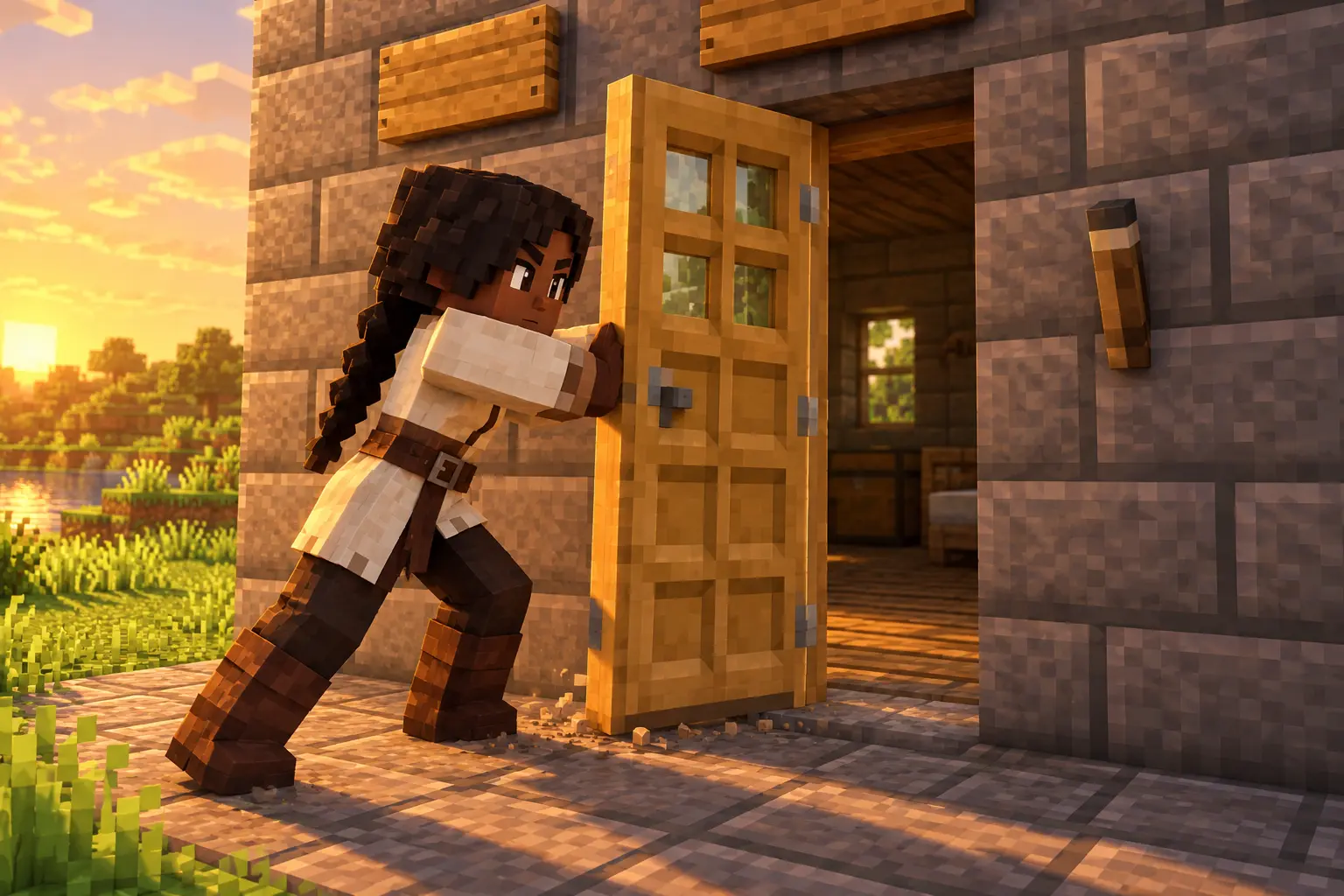
How to Make a Door in Minecraft at the Table
The craft uses six matching planks or ingots, set as two columns that touch and stand three blocks tall, with the third column left empty. Right-click the crafting table on Java Edition so the 3 by 3 grid is the one in front of you, not the inventory square.
Take three doors from the result slot. On Java Edition the recipe book can drop the ingredients into that grid once the table is open and you have held the items, which saves you from rebuilding the shape every time.
- Place the crafting table and right-click it.
- Fill the left column from top to bottom with the matching planks or ingots.
- Fill the middle column the same way so it touches the first column, and leave the right column empty.
- Move the doors from the result slot into your inventory.
The filled squares have to sit as one solid block, two wide and three high. Six planks split into the left column and the right column, with the middle column empty, are not that shape, and the result slot stays blank. Oak mixed with spruce, or any two woods in one grid, stays blank for the same reason.
You can put the two filled columns on the right side of the grid instead, as long as they still touch and the empty column is the one left over. What matters is the solid 2 by 3 block, not which edge of the table you start from.
Setting the Hinge When You Place a Door
Clear a gap one block wide and two blocks tall, with a full solid face under that gap. Right-click the top of that face. The bottom half of the door lands where you aimed, and the top half fills the block above it. If the gap is one block short, or the face under it is not a full solid face, the click does nothing at all.
Set that door the way Mojang’s note on door placement describes, on the top of a full block, an upside-down slab, or upside-down stairs. The door sits on the side of the block closest to you. Place it in the block your own body is standing in, and it shows up behind you instead of in the gap you wanted.
Water and lava flow around a door rather than stopping the way they stop against a solid wall. That is useful beside a river, and it is also why a door is a poor dam.
THE HINGE THE GAME PICKS
- Neighbor door: If another door is already beside the gap and its handle touches the new spot, the new door becomes a double door, with the handles together and the hinges on opposite sides.
- Solid jambs: With no door beside it, the hinge goes to the side that has more solid block faces next to the doorway.
- Java aim: On Java Edition, a tie, or a doorway with nothing on either side, puts the hinge on the side closest to your crosshair.
Since Java Edition 1.21, snapshot 24w21a, doors made of different materials line up as that pair instead of both hinging on the same side. If the swing is still into a wall, mine the door and place it again while you aim at the jamb that should hold the hinge.
Picture a hut with an oak plank floor and cobble walls, and a one-block gap in the middle of the front. Stand outside, aim at the plank that forms the threshold, and right-click. If both cobble jambs match, Java Edition follows your aim, so step toward the left jamb when you want the hinge on the left. Open the door once before night. If it swings into the cobble, mine it and favor the other jamb on the next click.
A double door needs a gap two blocks wide and two blocks tall. Place the first door, then the second so the handles meet, and they should swing away from each other. An iron pair still needs a redstone signal on each door, because a click will not move either half.
A closed door on Java Edition is 0.1875 blocks thick, which is 3/16 of a block, so you can still move through the rest of that space. Mobs can spawn in the block a door occupies, which means a dark threshold is not a safe patch of floor even after the door is in.
Which Minecraft Door Should You Craft?
The grid never changes. What changes is whether a click opens the door, whether a zombie can break it, and whether the spare door can feed a furnace. Wood and copper are for a door you, and a villager, should be able to use. Iron is for a door that should stay shut until you power it.
| Door | Ingredients | Doors made | How it opens | Furnace fuel | Hardness | Blast resistance |
|---|---|---|---|---|---|---|
| Wooden | 6 matching planks | 3 | Hand or redstone | 1 item, except crimson and warped | 3 | 3 |
| Copper | 6 copper ingots | 3 | Hand or redstone | None | 3 | 6 |
| Iron | 6 iron ingots | 3 | Redstone only | None | 5 | 5 |
Read the fuel cell with the Nether woods in mind. Crimson and warped craft like the other wooden doors, and they are the wooden doors that do not smelt. Hardness and blast resistance are why iron takes longer to punch and why it shrugs off a blast that would wreck an oak door.
Wooden Doors for a First Night
Right-click opens a wooden door on Java Edition, and a redstone signal can open it from the top half or the bottom half. Villagers, piglins, and copper golems can open wooden doors while they pathfind, and on Java Edition vindicators can open them too. A thrown wind charge flips a shut wooden door open, or an open one shut.
On Hard difficulty, zombies that can break wooden doors are the mobs to plan for, and Java Edition puts that ability on 5% of zombie spawns. Those zombies can break a copper door as well. They cannot break an iron door.
- First trees: Oak, spruce, birch, and jungle planks each make their own door, and you cannot mix them in one grid.
- Later overworld woods: Acacia, dark oak, mangrove, cherry, pale oak, and poplar use that same grid with their own planks.
- Bamboo: Bamboo planks make a bamboo door, still with the two touching columns.
- Nether: Crimson and warped doors open like other wood, and they will not fuel a furnace.
Overworld woods from that list can run a furnace, and the table shows the count of items one door smelts. A spare oak door is a weak fuel, useful when you are out of coal and you already have a stack of doors from one craft. Save crimson and warped for building, because they add nothing to the furnace.
Copper Doors You Can Open by Hand
A copper door opens with a click, the same as wood, and it also answers a redstone signal. Players, villagers, piglins, and copper golems can use it, and a wind charge will flip it, so it will not pen a villager the way iron will. Copper doors arrived with the Tricky Trials update in Java Edition 1.21, and an unwaxed one oxidizes after you place it.
- Place the copper door on the same full face you would use for oak.
- Leave it unwaxed if you want the color to move from copper to exposed, then weathered, then oxidized.
- Hold a honeycomb and use it on the door when the color is the one you want, which locks that stage.
- Wax it while it is still orange if the build should stay bright, or wait for the green and wax that instead.
An axe scrapes the wax off a door you locked too early, and that honeycomb is not returned. The same axe peels one oxidation stage from a door that is exposed, weathered, or oxidized. You can mine a copper door with any tool, and a pickaxe breaks it faster. It still drops itself, including when you mine the block underneath it.
Iron Doors That Need Redstone
Pick iron for a doorway mobs should not use on their own, because iron doors open only with redstone. A player cannot toggle one by clicking, and a wind charge cannot either. Villagers who stroll through a wooden door have no way through iron unless a signal is already on.
- Lever or button: Put it on a solid block beside the door and flip it so that block gets a weak redstone signal.
- Pressure plate: Set it on a block next to the door so walking up opens the path and stepping off lets the door shut.
- Either half: The signal can sit next to the top half or the bottom half, and the door still moves.
The door opens as soon as that neighboring block is powered, and it shuts as soon as the signal stops. Iron doors generate in strongholds, often with two stone buttons already set to open them, so you can watch a working pair before you spend six ingots at home. They also take a blast better than wood, which is the higher blast resistance in the table, and zombies do not break them.
A Door That Will Not Place or Open
When a door craft or a doorway fails, the grid or the block under your feet is usually the whole story. Run the checks before you assume the recipe changed.
CHECKS BEFORE YOU MINE THE DOOR
- Mixed ingredients: The result slot stays empty if the six items are not the same wood or the same metal.
- No support: Nothing is placed if the block under the door lacks a full solid face, or if the block above that face is not empty.
- Iron click: An iron door will not move when you right-click it, because it is waiting for redstone on a neighboring block.
- Wrong hinge: Mine the door and place it again while your crosshair favors the jamb that should hold the hinge.
- Split columns: Six planks with an empty column between them are not the door recipe, because the filled columns have to touch.
Zombies and raid vindicators only try to break a door that counts as closed, even if you turned the door sideways so the closed pose is the one that leaves a gap. Vindicators do this on Normal and Hard, and only while they are trying to reach a player, a villager, or a wandering trader. On Java Edition a vindicator may open a wooden door instead of breaking it.
That closed-state rule is why a sideways wooden door is a poor lock on Hard. The zombie still selects the door when the game calls it closed, then breaks it, even though you can see a gap. Iron skips that problem because zombies cannot break it, which is the point of spending the ingots.
Doors You Can Take From Structures
You do not have to spend the first ingots on a door. Wooden doors generate as entrances in villages, shipwrecks, and woodland mansions, and you can mine them with any tool and carry the item home. Zombie villages are the exception, because wooden doors do not generate there, so a village full of zombies will not hand you a free oak door.
Iron doors generate in strongholds, and the ones on those corridors often have two stone buttons already arranged to open them. Copper doors generate between rooms in trial chambers, which is a way to study the color and the click before you smelt a batch of your own. A door you mine is the same item as a door you craft, so the hinge rules still apply when you place it on your base, and a stronghold iron door still will not open by hand after you move it.
Frequently Asked Questions
Can You Wax a Copper Door in the Crafting Grid?
Yes. Put an unwaxed copper door and one honeycomb anywhere in the crafting grid and the output is that door with the wax on, at whatever oxidation stage it already has. Wax a fresh door this way if you want it to stay orange, or wax an oxidized door if you want the green locked in before you ever place it.
Will a Wooden Door Burn in Lava?
No. A wooden door set in lava does not burn, because there is no air around the door for a fire to catch. Java Edition and Bedrock Edition both let that door act as an air pocket in lava. Underwater, only Java Edition gives you air to breathe, because a Bedrock door is waterlogged and leaves the water where it is.
Do Wooden Doors Let Daylight Through?
Yes. Light passes through a wooden door, so a shut door does not make the room behind it fully dark. Some wooden doors have a small opening in the texture, and you can glance through it to see if it is day without stepping outside.
Do Zombies Break Doors on Bedrock Edition?
Yes, on Hard difficulty. Bedrock Edition gives zombies a 10% chance to spawn with the ability to break wooden doors, and zombified piglins are the exception. Iron doors still cannot be broken by zombies on that edition.
How Far Away Can You Hear a Minecraft Door?
A door opening or closing can be heard from 16 blocks away, the same reach as most mob sounds. A zombie hitting a wooden or copper door uses that same distance, so you can hear the attack before the mob is in view.
Stand outside the gap and watch which jamb the hinge takes before you go inside for the night. Wax a copper door when the color matches the build, and save iron for a doorway you can power from a lever, a button, or a plate.


Nesta Finds a Baby Blind Spot in Scotland’s GIRFEC Promise

FDA Closes Cyclospora Lettuce Probe Without Proving How

Pixel Watch 5 Discount Erases Google’s $50 Launch Hike

Pokémon GO Halloween 2026 Locks Candy Behind a Pass

ARX Robotics and Roboneers Tie Ukraine Combat to Western Fleets
Nesta Finds a Baby Blind Spot in Scotland’s GIRFEC Promise

OpenAI Turns ChatGPT Into a $1 Billion Ad Auction

Where to Cash a Comcheck: What to Do Before the Counter

Gottheimer’s AI LABS Act Enters an Already Crowded Field

The Yen Rally Was Funded by a Record Reserve Sale
-
 LIFESTYLE1 month ago
Nesta Finds a Baby Blind Spot in Scotland’s GIRFEC Promise
-
 BUSINESS3 months ago
OpenAI Turns ChatGPT Into a $1 Billion Ad Auction
-
 BUSINESS3 years ago
Where to Cash a Comcheck: What to Do Before the Counter
-
 NEWS2 months ago
Gottheimer’s AI LABS Act Enters an Already Crowded Field
-
 BUSINESS2 months ago
The Yen Rally Was Funded by a Record Reserve Sale
-

 SCIENCE3 years ago
Where to Get a Mantoux Test: Clinics That Place and Read It
-

 BUSINESS2 months ago
Ostrich Farms Rebuild Around a Tick-Bite Meat Allergy
-

 NEWS2 months ago
Coremail Pitches AI-Native Email Security at LEAP 2026