
BUSINESS
OpenAI Turns ChatGPT Into a $1 Billion Ad Auction
ChatGPT Ads hit a $1 billion yearly pace in under 200 days, copying Google’s auction while remaining tiny beside Search.

OpenAI said Monday that ChatGPT Ads reached $1 billion in annualized revenue run rate in less than 200 days. Alphabet’s Class C shares (GOOG) closed at $335.41, down 2.18%, then slipped another 1.01% on Tuesday to $332.03.
The $1 billion figure is this month’s pace times 12, not a year of cash already booked. It drops OpenAI into the same high-intent auction Alphabet has run for two decades, and it remains well short of the $2.5 billion advertising target the company has described for 2026.
A $1 Billion Snapshot, Not a Full Year
OpenAI framed advertising as one pillar beside subscriptions, enterprise contracts, and usage-based APIs, and as the way it keeps a free tier in front of more than 1 billion weekly active users. Ads show on Free and on ChatGPT Go, the $8-a-month plan. Paid Plus, Pro, Business, Enterprise, and Education accounts stay ad-free.
The yearly pace implies about $83 million a month. That is a snapshot of August, not a receipt for 2026. A U.S. test that crossed a $100 million yearly pace within six weeks of launch is now running ten times that fast, with tens of thousands of advertisers and a presence in over 40 countries.
FROM A FEBRUARY TEST TO A GLOBAL AUCTION
- January 16, 2026: Fidji Simo publishes OpenAI’s ads principles, promising labeled placements that stay separate from answers.
- February 9, 2026: A U.S. test starts for logged-in adults on Free and Go, with ads at the bottom of relevant answers.
- March 26, 2026: OpenAI says the pilot has crossed a $100 million yearly pace within six weeks, with more than 600 advertisers.
- May 5, 2026: A beta Ads Manager opens in the United States, with cost-per-click bidding plus pixel and Conversions API measurement.
- August 31, 2026: OpenAI posts the $1 billion yearly pace and turns on self-serve buying in India, Europe, the Middle East, and North Africa.
Dave Dugan, vice president of global ad solutions, called the company “at the beginning of a new chapter for advertising,” and said reaching $1 billion in ARR in under 200 days “shows the scale of the opportunity ahead.” CPC and outcome-based bidding now make up most campaigns, which is the same shift Google’s own auction made years ago.
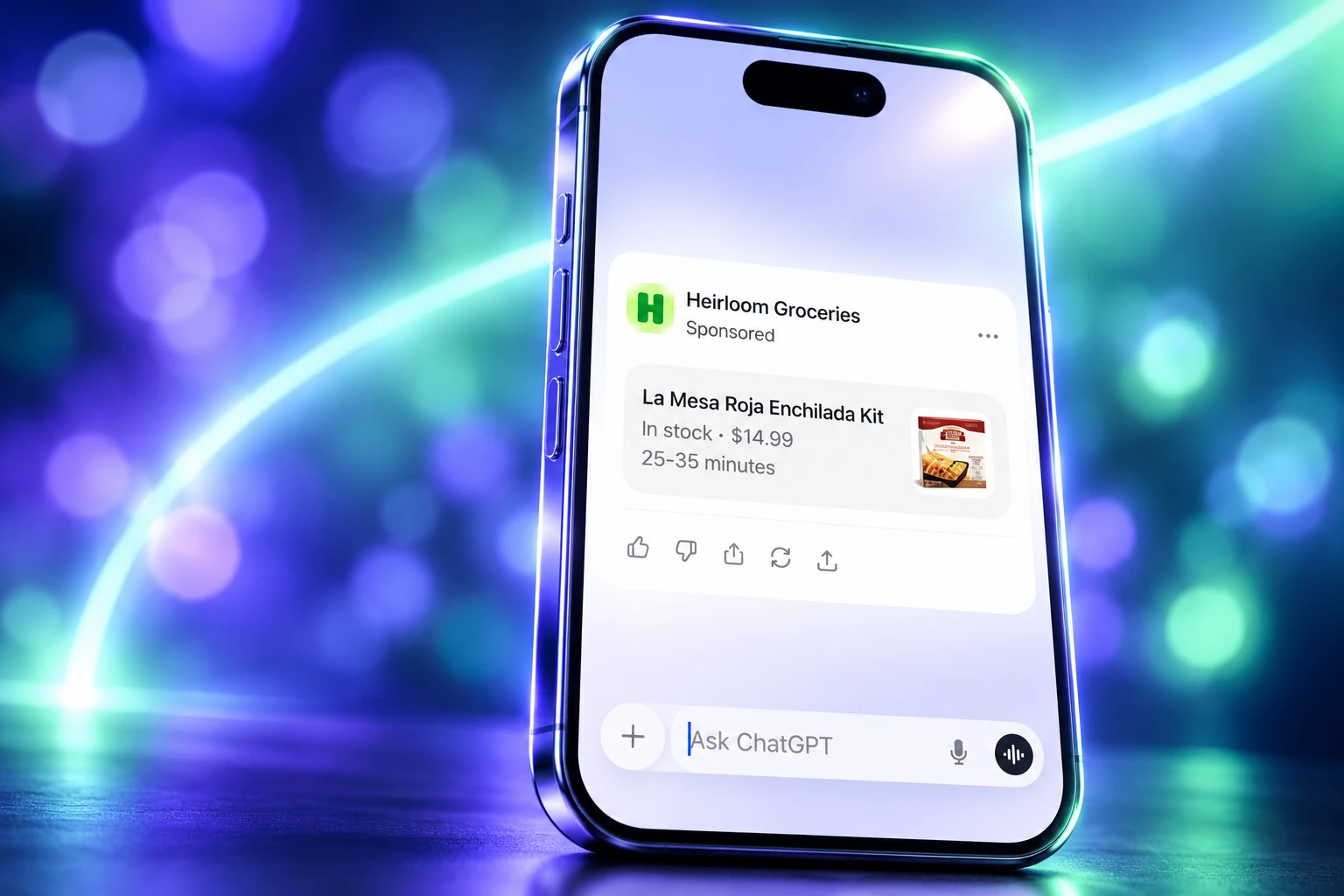
ChatGPT Now Sells the Slot Under the Answer
The unit is a labeled Sponsored card that can appear after ChatGPT finishes a reply, matched to the live conversation and, if a user allows it, to broader ChatGPT activity. OpenAI says the model and the ad system run apart, so a paid placement cannot rewrite the answer above it.
That split is the product promise. It is also the constraint. A brand can rent the slot under the answer. It cannot buy its way into the recommendation ChatGPT just wrote. The January note said ads do not influence ChatGPT answers, that conversations stay private from advertisers, and that OpenAI will not optimize for time spent in the chat.
The harder test is whether that wall holds once tens of thousands of bidders are paying for the moment a user states a budget, a deadline, and a brand preference in the same thread. Conversational intent is richer than a five-word query. It is also easier to spoil. If the card under the answer starts to feel like a results page, the free tier that ads are meant to fund gets cheaper to users in a different way.
WHO SEES CHATGPT ADS
- Free and Go: Adult users on these plans can be shown a labeled Sponsored card after an answer.
- Higher paid tiers: Plus, Pro, Business, Enterprise, and Education accounts do not get ads.
- Minors: OpenAI says it will not show ads in accounts it is told, or predicts, belong to someone under 18.
- Sensitive topics: Ads are not eligible next to health, mental health, or politics.
Free users can accept fewer daily messages instead of ads. Go users cannot turn the ads off. Both groups can dismiss a unit, shut off personalization, and clear ads data. Advertisers get aggregated views and clicks, not the chat transcript.
$1 Billion Against Google’s $81.6 Billion Ad Quarter
Alphabet’s June quarter still dwarfs the new auction. Google advertising booked $81.6 billion in those three months. Search and other advertising, the closest cousin to ChatGPT’s high-intent slot, booked $63.3 billion, up 17%.
GOOGLE’S Q2 AD BOOK BESIDE A $1 BILLION PACE
| Business | Latest figure | Annualized equivalent |
|---|---|---|
| ChatGPT Ads | $1.0 billion run rate (August 31) | $1.0 billion |
| Google Search & other | $63.3 billion in Q2 | $253.2 billion |
| YouTube ads | $11.1 billion in Q2 | $44.4 billion |
| Google advertising total | $81.6 billion in Q2 | $326.4 billion |
At that annualized ad total, OpenAI’s new pace is about 0.3%. Alphabet also posted Google Services revenue of $94.5 billion for the quarter, up 15%, on $119.8 billion of company revenue. YouTube ads rose 13% to $11.1 billion. Network ads slipped 1% to $7.3 billion. Cloud, the other AI story inside Alphabet, jumped 82% to $24.8 billion.
Tuesday’s close left the Class C stock at a $4.06 trillion market value. Monday’s drop landed in a tape that had already been chopping around AI costs and staff moves, so the ads post was a fresh headline on a name that was already for sale. Google Search still grew in the double digits in the same year a chatbot opened a second checkout line.
Self-Serve Tools Reach India and Europe
The May Ads Manager was the moment the product stopped looking like a managed pilot and started looking like an ad network. Businesses can register, set budgets and bids, upload creative, and read performance without going back to OpenAI’s sales desk. Monday’s switch flipped that self-serve door for eligible buyers in India, Europe, the Middle East, and North Africa.
OpenAI began with agencies and a partner channel, including Dentsu, Omnicom, Publicis, and WPP, plus technology firms such as Adobe, Criteo, Kargo, Pacvue, and StackAdapt. It now cites more than 50 technology and measurement partners. Small and midsize firms, it said, “represent a material share of the business,” and advertisers outside the United States are a growing slice of revenue.
Early proof points are still company examples, not a public ledger. One ecommerce advertiser, OpenAI said, recorded a 3x return on ad spend across 28 days. A technology partner said more than 80% of ad-driven ChatGPT traffic came from new customers. Those figures are what a sales team puts on a slide. They also show why a search buyer would park a test budget in the new auction: the user has already described the job to be done.
A $2.5 Billion Goal That Needs a Faster Month
Speed is not the same as a year. A research note on OpenAI’s books $2.5 billion in 2026 ad revenue as the internal target, with $100 billion by 2030. A $1 billion yearly pace is 40% of that 2026 goal if both numbers were run rates, and it is a longer climb as a calendar total because the product did not exist in January.
Incredibly impressive and terribly disappointing
Nate Elliott, AI analyst at eMarketer
Elliott’s line is the cleanest read of Monday’s number. Hitting $1 billion of yearly pace this fast is rare for a new ad unit. Using that same pace as evidence that 2026 ad sales will land at $2.5 billion is a stretch unless monthly take jumps hard through the fourth quarter, which is exactly what the global self-serve rollout is built to try.
WPP Media has put generative AI search ads on a path to $100 billion worldwide by 2030, with spend split between OpenAI and Google. That is a category forecast, not a booking. For OpenAI, ads are also a listing story. The company has confidentially filed for a U.S. IPO, and a diversified model that includes a free, ad-supported ChatGPT is part of the pitch that subscriptions and API usage are not the only way to pay for the models.
Where Google Still Collects the Query
Alphabet is not waiting to be copied. On the July 22 earnings call, Sundar Pichai, CEO of Google and Alphabet, said people are using one Search path across AI Overviews and AI Mode, and that Search and other revenue grew 17%. AI Mode, he said, has passed 1 billion monthly users since a global expansion last October, and AI features in Search are sending billions of clicks to websites each week.
Philipp Schindler, Google’s chief business officer, said the company is pushing Gemini through ads quality, advertiser tools, and AI user experiences, including better matching on longer queries that used to be hard to sell. That is the incumbent’s answer: keep the query, dress it in AI, and charge against it with an auction that already has millions of buyers and years of measurement.
Google Cloud’s 82% jump matters here too. The same company that sells the search slot is selling the chips and models other firms use to build rivals. OpenAI’s new ad dollar does not show up as a hole in that $63.3 billion Search line. It shows up as a second place a shopper can finish a decision without typing into a search box.
An Auction That Never Leaves the Thread
The quiet shift is traffic. A labeled card under an answer can send a user to a landing page, and OpenAI is selling clicks, not only impressions. Many commercial chats will still end inside ChatGPT. The comparison, the shortlist, and the “what should I buy” moment used to leak out to publishers and to Google’s blue links. Now a share of that moment has a native checkout sitting under the reply.
Publishers already live with AI Overviews skimming their pages. A chatbot that both answers and sells is another cut. OpenAI says it will not chase time-on-site, and that ads stay out of health and politics. Buyers will still press for more formats, more retargeting, and a closer tie between the answer and the sale. Each of those asks chips at the January rules.
Some media buyers will move a slice of search spend into ChatGPT because the prompt already carries intent that a keyword match has to guess at. The $1 billion pace makes that experiment rational. It does not yet make OpenAI a replacement for Google’s ad book, and it does not yet fund a $2.5 billion year. Monday opened the door wider. The next few months of self-serve bids will show whether the card under the answer is a side channel or a second search box.
Disclaimer: This article is news reporting and analysis for general information only. It is not investment advice, a recommendation to buy or sell Alphabet or any other security, and it is not a forecast of OpenAI’s private value or IPO timing. Readers should consult a licensed financial adviser or securities professional before making any investment decision. Figures, product rules, and trading prices reflect company statements and market data as of September 2, 2026, and may change with later disclosures, earnings, or sessions.

Nesta Finds a Baby Blind Spot in Scotland’s GIRFEC Promise

FDA Closes Cyclospora Lettuce Probe Without Proving How

Pixel Watch 5 Discount Erases Google’s $50 Launch Hike

Pokémon GO Halloween 2026 Locks Candy Behind a Pass

ARX Robotics and Roboneers Tie Ukraine Combat to Western Fleets

Where Can I Cash a Comcheck – What Are My Options?

Arm Bets Compute Subsystems Will Reach Physical AI

The Yen Rally Was Funded by a Record Reserve Sale

OpenAI Turns ChatGPT Into a $1 Billion Ad Auction

Coremail Pitches AI-Native Email Security at LEAP 2026
-
 LIFESTYLE3 years ago
Where Can I Cash a Comcheck – What Are My Options?
-
 BUSINESS1 month ago
The Yen Rally Was Funded by a Record Reserve Sale
-
 NEWS1 month ago
Arm Bets Compute Subsystems Will Reach Physical AI
-
 NEWS1 month ago
Coremail Pitches AI-Native Email Security at LEAP 2026
-

 NEWS1 month ago
Gottheimer’s AI LABS Act Enters an Already Crowded Field
-

 BUSINESS1 month ago
Ostrich Farms Rebuild Around a Tick-Bite Meat Allergy
-

 TECHNOLOGY3 years ago
How Many Cards in a Uno Deck – What’s the Exact Number?
-

 LIFESTYLE3 years ago
Where to Get a Mantoux Test – What Are the Available Locations?