BUSINESS
Where to Cash a Comcheck: What to Do Before the Counter
Where to cash a Comcheck depends on a registered draft and a vendor call for an authorization number. Truck-stop counters and some banks will take it.

A Comchek is the paper draft Comdata uses to pay out a set amount of money, and drivers also spell it Comcheck. A carrier, a broker, or your own card put funds on it. You need that money as cash, as a payment to a lumper, or as a deposit at your bank.
Where to cash a Comcheck is a shorter list than a normal paycheck. The counters that finish the job are major truck stops that take Comdata, and banks that will phone Comdata. A Walmart MoneyCenter is the wrong desk.
The paper has to be registered first, and the person accepting it has to get an authorization number from Comdata. This page covers that call, the lines you fill in, and which counter fits the errand you are on.
What Is a Comchek Draft?
A Comchek draft is a paper way to move a fixed sum, close to a blank check that is worth money only after Comdata ties an amount to that exact piece of paper. Comdata’s description of a Comchek draft calls it one of the company’s oldest products for fleets. Carriers use it for payroll and cash advances. Drivers use it on the road for a lumper, a repair, fuel, or a fine when the other party will not take a card.
The code that gives the paper its value is an express code. Comdata describes it as a numeric code of 14 to 18 digits that stands for a specified dollar amount. That same page says a draft cannot be cashed or deposited until the express code is registered to the Comchek and Comdata has authorized it. After you fill the draft in, Comdata says you can cash it or deposit it with no fee from Comdata.
People say Comcheck for three different things, and the counter does not treat them as the same tender. Read the row that matches what is in your hand before you choose a desk.
| What you hold | What it pays | What has to happen first |
|---|---|---|
| Paper Comchek draft | The amount registered to that draft number | You register it, then the store or bank gets an authorization number |
| Express code | One set dollar amount inside the code | The cashier enters the code and the payee name |
| Comdata card | The balance on the card, plus cash back if the store allows it | A PIN, at a store that takes the card |
The card stays in your wallet and can be loaded again. Comdata’s purchase steps say you can use it at a store that shows the Maestro brand, and a PIN debit sale can include cash back up to the limit that store sets. A draft and an express code are one-time amounts. They do not reload, and a code someone else has already spent is gone.
That split is why one fuel desk can refuse the plastic card and still cash a draft, or the other way around. If a dispatcher read you a code, you are on the express-code row. If you are holding a blank check with a number in the top right corner and the money is still on your card, you are on the draft row and you have a phone call to make first.
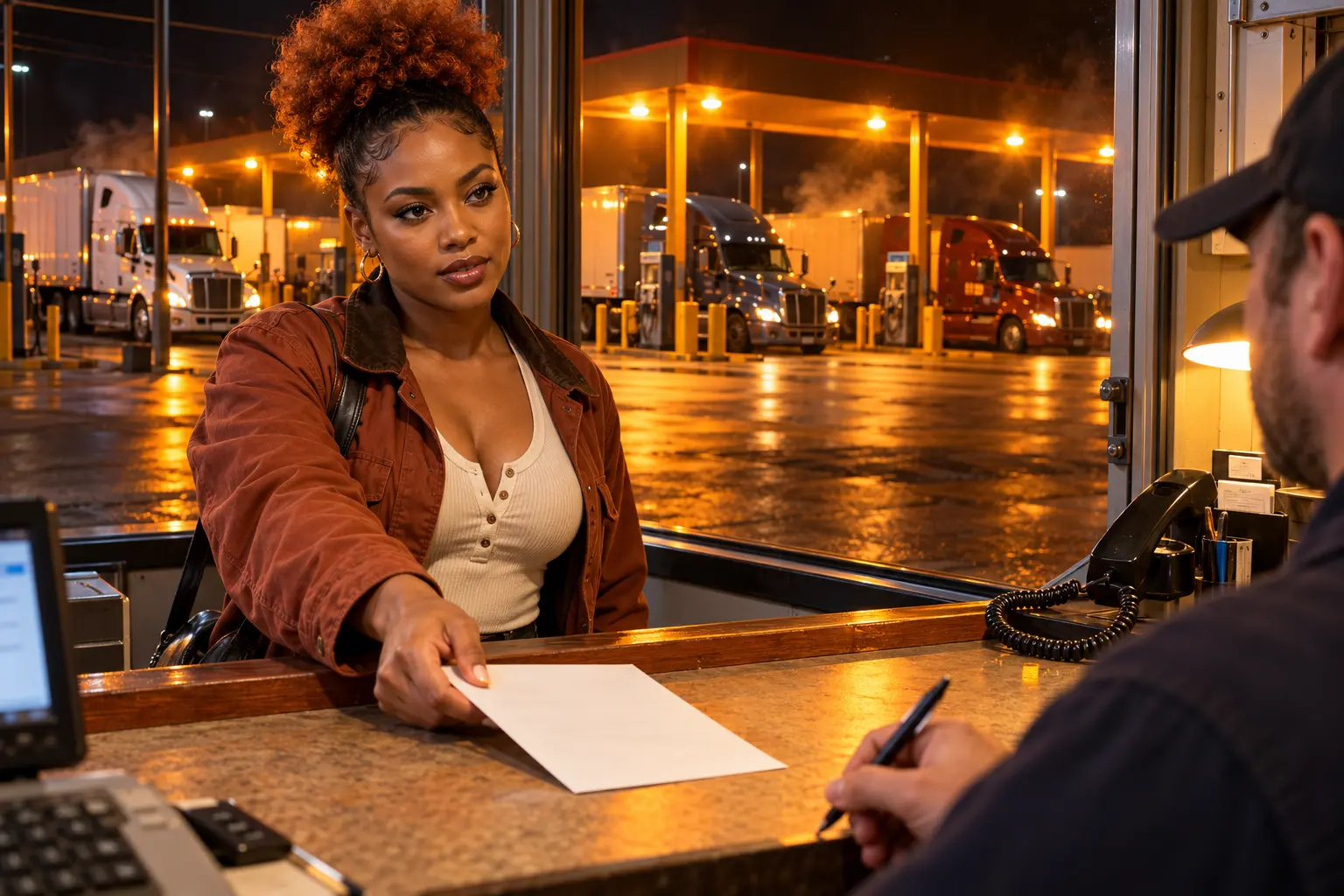
The Two Phone Calls a Comchek Needs
Two different Comdata lines get mixed up, and calling the wrong one is why a finished-looking draft still dies at the counter. You use one line to put money from your card onto the paper. The store, the bank, or the lumper uses the other line to get the authorization number that makes the paper good.
Comdata’s draft registration sheet states the rule in one note:
The Comchek draft is not valid and will not be honored without obtaining an authorization number before cashing or accepting for payment. When presenting the check to be cashed, ensure that an authorization number has been obtained by having the vendor call 1-800-741-3030.
Comdata, Registering a Comchek Draft
THE TWO COMDATA LINES
- Your line: Call 1-800-741-6060 from a touch-tone phone to set a PIN, hear the cash on the card, and register the draft.
- The vendor line: The truck stop, bank, or lumper calls 1-800-741-3030, gets the authorization number, and writes that number on the draft.
Your job on the vendor line is to stand there while they call, not to fetch the authorization number yourself and hope the clerk trusts it. The number has to land on the draft from that call. If the person at the counter will not dial, this is the wrong counter, even if the sign out front belongs to a chain that cashes drafts at other stores.
Ask your company administrator whether cash access is turned on for the card before you start. The registration sheet tells you to check that. If cash access is off, the phone line has no cash to move onto the paper, and a friendly clerk cannot invent it.
How to Register a Comchek From Your Card
Use this path when the money is still sitting in the cash limit on your Comdata card and you have a blank draft. If a broker or dispatcher already issued an express code for a set amount, you do not load the draft yourself. You take that code to a counter that will authorize it.
Start with the PIN if this card has never had one. Comdata’s first-time registration steps say the PIN is four digits, and they rule out four patterns: a run such as 1234, four copies of one digit such as 2222, the first four or last four digits of the card, and the last four digits of your Social Security number. The PIN setup page also has you enter the full 16-digit card number.
- Call 1-800-741-6060, enter the card number, and press the pound key. Enter the PIN, then enter it again and press pound. When the second entry matches, the line tells you the PIN is registered to the card.
- Do not tell anyone the PIN and do not write it on the back of the card. If you forget it, your card administrator has to reset it before you can choose a new one. You cannot ask Comdata to look the old one up.
- Find the draft number in the top right corner of the paper. That number is what you will key, not the amount and not your card number.
- Call 1-800-741-6060 again. After you hear the cash limit, follow the draft-registration prompts. One Comdata script has you press 1 for draft registration at the start.
- Enter the amount with no decimal point, then pound. Comdata’s own examples are 10000# for $100.00 and 9532# for $95.32. You do not have to empty the card. Leave the rest of the cash limit there and draw it later.
- Listen while the line repeats the amount. Confirm it. If the script offers a cancel key, this is the moment to stop a wrong amount, before you enter the draft number. One Comdata script uses 1 to accept the amount and 2 to cancel.
- Enter the draft number from the top right corner and press pound. Wait. The registration page says the line answers “Your draft has been registered.” The cash-limit script says “Your transaction is complete.” Either line means the money is now tied to that draft.
Hang up only after you hear one of those two sentences. A balance reading is not registration. If you key the amount with a decimal in your head and drop the cents, the paper and the phone record will not match, and the counter will be authorizing a different sum than the one you wrote.
How to Fill In a Comchek Draft
Registration moves the money onto a draft number. The writing on the face still has to name the same amount, the payee, and you. Comdata’s first-time steps list every field the paper asks for.
WHAT EACH LINE TAKES
- Date: Put the date you are using the draft in the date field.
- Payee: Write your name if you are cashing it, or the business name if you are paying a lumper or a shop.
- Written amount: Write the sum in words on the line for the sum, in the same style as the sample on Comdata’s sheet, “Twenty Five Dollars and no/100.”
- Dollars box: Put the figures in the dollars field. The sample sheet uses 25.00 next to that written line.
- Company: Put your employer’s name in the company name field.
- Card or code: Put your Comdata card number in the card number or express code field.
- Phone: Put your home phone in the payee phone field.
- License: Put the state that issued your driver’s license, then the license number in the identification field.
- Authorization: Leave the authorization line blank so the vendor can write the number they get from 1-800-741-3030.
The words and the figures have to be the same dollars you registered. If you registered $95.32, the phone key was 9532# and the face of the draft should show that same $95.32, not a rounded $95 and not the $100 you meant to register before you confirmed the prompt. The sample wording on the sheet, “Twenty Five Dollars and no/100” with 25.00 in the box, is the pattern, not a required amount.
Leave the back blank until you are at the counter and ready to take cash. Comdata repeats that rule: do not endorse a draft you are cashing until that moment. If the draft is payable to a business, a lumper, or another bill, you do not endorse it at all. Signing early gives anyone holding the paper a signed instrument, and it also leaves you with a signature on a draft a clerk may still refuse.
Where to Cash a Comcheck After Registration
Comdata says a correctly filled draft can be cashed or deposited with no fee from Comdata. The desk in front of you can still charge its own fee for the service. Ask what that fee is, and what it is for, before you sign the back. Drivers who ask at the counter are sometimes told the charge is simply for accepting a Comchek.
| Your situation | Where to go | Confirm this first |
|---|---|---|
| Cash you registered from your card onto a blank draft | A truck-stop fuel desk that takes Comdata, or your bank | The draft is registered, and they will call 1-800-741-3030 |
| An express code from a broker or dispatcher | That same kind of fuel desk | The code, the amount, and your name as the payee |
| A lumper, a shop, or another bill | The business you are paying | The draft is payable to them, and they will call for the number |
| A deposit, not cash in hand | Your own bank | The teller will get the authorization number |
Pick the row that matches the errand, then use the steps under that row. The authorization call is the same in every row. The payee and the signature are not.
Truck Stops That Take Comchek Drafts
The travel centers where drivers actually present these drafts are the big chains that already run Comdata at the fuel desk: Pilot Flying J, Love’s Travel Stops, TravelCenters of America, Petro, Road Ranger, and Sapp Bros. A chain name on the building is not a promise that this particular counter cashes drafts. A driver who pulled into a Pilot Flying J to cash a Comchek was told that store did not cash them.
ASK AT THIS DESK
- The call: Ask whether this counter will phone Comdata and write the authorization number on the draft.
- The fee: Ask what they charge to cash it, and whether that fee comes out of the draft.
- The cash: Ask if the drawer can cover the amount before you endorse.
You do not have to buy fuel to make the draft eligible. The register guide Verifone publishes for stores that take this tender says a Comchek can be cashed without buying any product. A store can still prefer a purchase. That preference is the store’s rule, so ask, and do not sign until the answer is yes. Count the cash against the draft amount minus any fee they named, and keep the receipt with the draft copy.
A Bank That Will Call Comdata
Your own bank can cash the draft or take it as a deposit once a teller gets the authorization number. Comdata’s no-fee line applies to that cashing or deposit on Comdata’s side. It does not force a bank that has never seen the paper to open a teller window for a non-customer. Drivers who do not keep an account at a large national bank often find the only deposit that works is the one at their own bank, back home, not a branch they happen to pass.
BEFORE YOU ENDORSE
- The call: The teller agrees to phone 1-800-741-3030 and to write the authorization number on the draft.
- The signature: You sign the back only after that number is on the paper and the teller has accepted it.
If the teller will not make the call, do not leave the draft and do not sign it to “let them research it.” Take it to a fuel desk that will dial. A signed draft sitting in a drawer you cannot see is harder to unwind than a blank one still in your pocket.
Paying a Lumper With a Comchek
A lumper who wants money before the trailer is empty is the reason a lot of these drafts exist. Write the draft to that business instead of to yourself, and you skip the extra stop to turn paper into cash.
- Register the exact amount the lumper is charging, using the phone steps above, before you hand the paper over.
- Make the draft payable to the lumper or the warehouse, fill in the figure line so it matches the registered amount, and leave the back unsigned. Comdata says endorsement is not needed when the draft pays a bill.
- Stay at the dock or the service desk while they call 1-800-741-3030 and write the authorization number on the face. Do not leave the paper with someone who says they will “call it in later.”
Warehouse docks often want cash or a Comchek on the spot, which is why waiting on dispatch for the code can take longer than the unload itself. Get the amount and the payee name from the dock before you register, so you do not lock the wrong dollars onto the draft.
Cashing an Express Code at the Counter
An express code with no paper in your hand is still a one-time amount, and the cashier has to enter it as its own tender. Read the code back to the person who issued it before you drive. Comdata’s draft page puts that code at 14 to 18 digits, so a short string that does not match what dispatch sent will not go through. Ask what dollar amount was loaded, because the drawer pays that amount, minus any fee the store takes, and not a number you rounded in your head.
Verifone’s register setup shows what the cashier is prompted to type on an express-code sale. The payee name is required after the amount, with a comma between the first name and the last name. The unit number is optional on an express-code sale and required on other Comdata sales. Have your license out so the name you give matches the license. On a paper draft the same register asks for the amount, a unit number, and the Comchek number.
Treat the code like cash in your pocket. A code that another person can see can be used up before you reach the desk, and Comdata will not print a second copy of money that is already gone. Write it down once, confirm it with dispatch, and do not text it to a group.
What to Do When a Comchek Is Refused
A refusal is usually a mismatch the clerk can see, or a counter that was never going to make the call. Walk the list before you drive to a second store and register another draft.
WHY THE COUNTER SENDS YOU AWAY
- Not registered: The draft number was never phoned in, so there is no amount for Comdata to authorize.
- No authorization: You have a registered draft, but nobody has called 1-800-741-3030 and written the number on it.
- Amount clash: The figures on the face are not the figures you keyed, cents included.
- Signed too soon: The back is already endorsed and the clerk will not take it.
- PIN rejected: The PIN is a run of digits, four identical digits, part of the card number, or the last four of your Social Security number, or the card administrator never turned cash access on.
- Wrong desk: Walmart’s check-cashing page lists payroll checks, government checks, tax checks, and MoneyGram money orders. A Comchek is not on that list, and it is not a preprinted payroll check.
- Code already used: Someone else spent the express code, so the amount is no longer there.
Fix the item that failed instead of rewriting the same draft. A PIN problem goes to your card administrator for a reset, then back to 1-800-741-6060 for a new PIN. A store that will not dial is a store you leave, with the back of the draft still blank. Walmart will not become an option because a manager is in a good mood. Its published list is payroll, government, tax, and those money orders.
If the automated line will not register the draft at all, switch to the help line for your card type rather than guessing a third 800 number from an old receipt. Have the card number in your hand when you call. The help line can look at the account. It still cannot authorize a draft in place of the store.
Frequently Asked Questions
Can I Register a Comchek in the App?
Comdata lets you register a Comchek from its own mobile apps, and the account website uses a Transfer screen. Choose Create Comchek, pick the card the money comes from, enter the draft number and confirm it, enter the amount, then review and confirm the transfer. The automated phone line is the path on the printed registration sheet when you do not already have the app signed in.
Who Resets a Comdata PIN I Forgot?
Your card administrator resets a PIN you no longer know, and you choose a new four-digit PIN on the automated line after that reset. The cardholder agreement says only you know the PIN, so Comdata and the company that loads the card cannot read the old one back to you. Keep the new PIN off the card and out of anyone else’s hands.
What If the Amount on the Draft Is Wrong?
Leave the draft alone if the dollars you wrote do not match the amount you registered. Do not scratch out a figure or write a second amount on top. A carrier handout for this process says the bank or the truck stop can call Comdata to void a draft written for a different amount than the registered one, and that the void works only when the draft was registered correctly to begin with. Call your card administrator before you try to spend that same piece of paper.
Where Do I Get a Blank Comchek?
Your company orders blank Comchek drafts from Comdata and hands them out. Truck stops that already handle these drafts may keep blanks at the counter or print one when you give them an express code and your driver information. Without the paper or a code, the counter has nothing to send to Comdata for an authorization number.
Which Number Do I Call When the Phone Line Fails?
Comchek cardholders call 1-800-741-3939, and OnRoad cardholders call 1-866-288-9990. Have the card number ready and follow the prompts. Those lines are account help. They do not replace the call the store makes on 1-800-741-3030 to get the authorization number.
Leave the back of the draft blank until the person who is about to pay you has the authorization number written on the front. If that person will not call 1-800-741-3030, this counter is finished, and the next one has to be a fuel desk or a bank that will dial.


Nesta Finds a Baby Blind Spot in Scotland’s GIRFEC Promise

FDA Closes Cyclospora Lettuce Probe Without Proving How

Pixel Watch 5 Discount Erases Google’s $50 Launch Hike

Pokémon GO Halloween 2026 Locks Candy Behind a Pass

ARX Robotics and Roboneers Tie Ukraine Combat to Western Fleets

OpenAI Turns ChatGPT Into a $1 Billion Ad Auction

The Yen Rally Was Funded by a Record Reserve Sale

Where to Cash a Comcheck: What to Do Before the Counter

Ostrich Farms Rebuild Around a Tick-Bite Meat Allergy

Where to Get a Mantoux Test: Clinics That Place and Read It
-
 BUSINESS2 months ago
OpenAI Turns ChatGPT Into a $1 Billion Ad Auction
-
 BUSINESS2 months ago
The Yen Rally Was Funded by a Record Reserve Sale
-
 BUSINESS2 months ago
Ostrich Farms Rebuild Around a Tick-Bite Meat Allergy
-
 SCIENCE3 years ago
Where to Get a Mantoux Test: Clinics That Place and Read It
-

 NEWS2 months ago
Gottheimer’s AI LABS Act Enters an Already Crowded Field
-

 NEWS2 months ago
Coremail Pitches AI-Native Email Security at LEAP 2026
-

 NEWS2 months ago
Arm Bets Compute Subsystems Will Reach Physical AI
-
 LIFESTYLE1 month ago
Nesta Finds a Baby Blind Spot in Scotland’s GIRFEC Promise