
NEWS
ARX Robotics and Roboneers Tie Ukraine Combat to Western Fleets
ARX Robotics and Roboneers signed a Kyiv UGV pact that feeds Ukrainian combat into Western land systems, while a 50,000-unit year still outruns the factory.

ARX Robotics and Roboneers signed a land-warfare pact in Kyiv on October 4, with Chancellor Friedrich Merz and President Volodymyr Zelenskyy present. The Munich firm and the Ukrainian maker already supply ground drones to Ukraine’s armed forces. The new paper covers system integration and joint development, and it sits on a production joint venture the two companies formed in June.
Marc Wietfeld, co-founder and chief executive of ARX Robotics, said the work is meant to put a smart unmanned fleet into Ukrainian hands at scale and to fold front-line lessons into land systems built for other Western armies. That second job is the part the ceremony does not print in large type.
What the Kyiv Partnership Changes
The October 4 agreement covers system integration and joint development. It does not open a new factory. ARX Industries, signed in Gdańsk on June 25, already exists to build the Rys Pro in Germany and Ukraine. Kyiv adds the software layer meant to run both fleets as one.
ARX’s LinkedIn post from the signing put the same split in writing: the June joint venture stays the production vehicle, and the new pact is about closer technical integration. Ukraine’s government, the company repeated, estimates demand at 50,000 unmanned ground systems in 2026. Meeting that number, ARX said, takes both technology and industrial capacity.
Together with Roboneers, we provide the Ukrainian forces with a robust but smart UGV fleet at scale and at the same time ensure that the lessons learnt from the battlefield are incorporated into the land systems development of other Western armies.
Marc Wietfeld, co-founder and CEO, ARX Robotics
Anton Skrypnyk, executive chairman of Roboneers, said in June that Ukraine has proven robots win battles. Maximilian Wied, co-founder and chief financial officer of ARX, put the human cost in one line: every week without the right equipment costs lives. The Kyiv overlay is how those two claims are supposed to share a fleet, not just a press photo.
Ukraine Asked for 50,000 Ground Robots in 2026
President Volodymyr Zelenskyy told the defence minister and the General Staff to field at least 50,000 ground robotic systems this year, calling the work protection of life. Logistics, casualty evacuation and combat tasks, he said, should move onto machines wherever they can. Defence Minister Mykhailo Fedorov had already set a first-half mark of 25,000 systems, a figure ARX repeated when it announced its own Gereon expansion.
Those two numbers are not the same order. The 25,000 figure is a contracting plan for the first half of 2026. The 50,000 figure is the full-year political target. Neither is a purchase order on ARX Industries or on the Ulm Gereon line.
THE SCALE THE DEAL IS CHASING
- National target: Ukraine wants 50,000 unmanned ground systems in 2026.
- First-half plan: Fedorov said 25,000 systems would be contracted in the first half of the year.
- Rys Pro factory aim: ARX Industries wants several thousand units in year one and tens of thousands a year later.
- Gereon contract: ARX said a May award adds several hundred vehicles and lifts the Ukraine fleet to five times its initial size.
ARX calls Gereon the largest Western-built unmanned ground fleet now in Ukraine, with hundreds of vehicles already in operation or contracted. In August it said that, with Roboneers, it had handed over 30 UGVs to a Ukrainian regiment for logistics, evacuation and ammunition resupply at the same time. Estonia’s Milrem has spoken of delivering over 150 THeMIS vehicles to Ukraine by the end of 2026. Stack those Western lines against 50,000 and the gap is the story, not the handshake.
Two Robots Share a Front and Split the Work
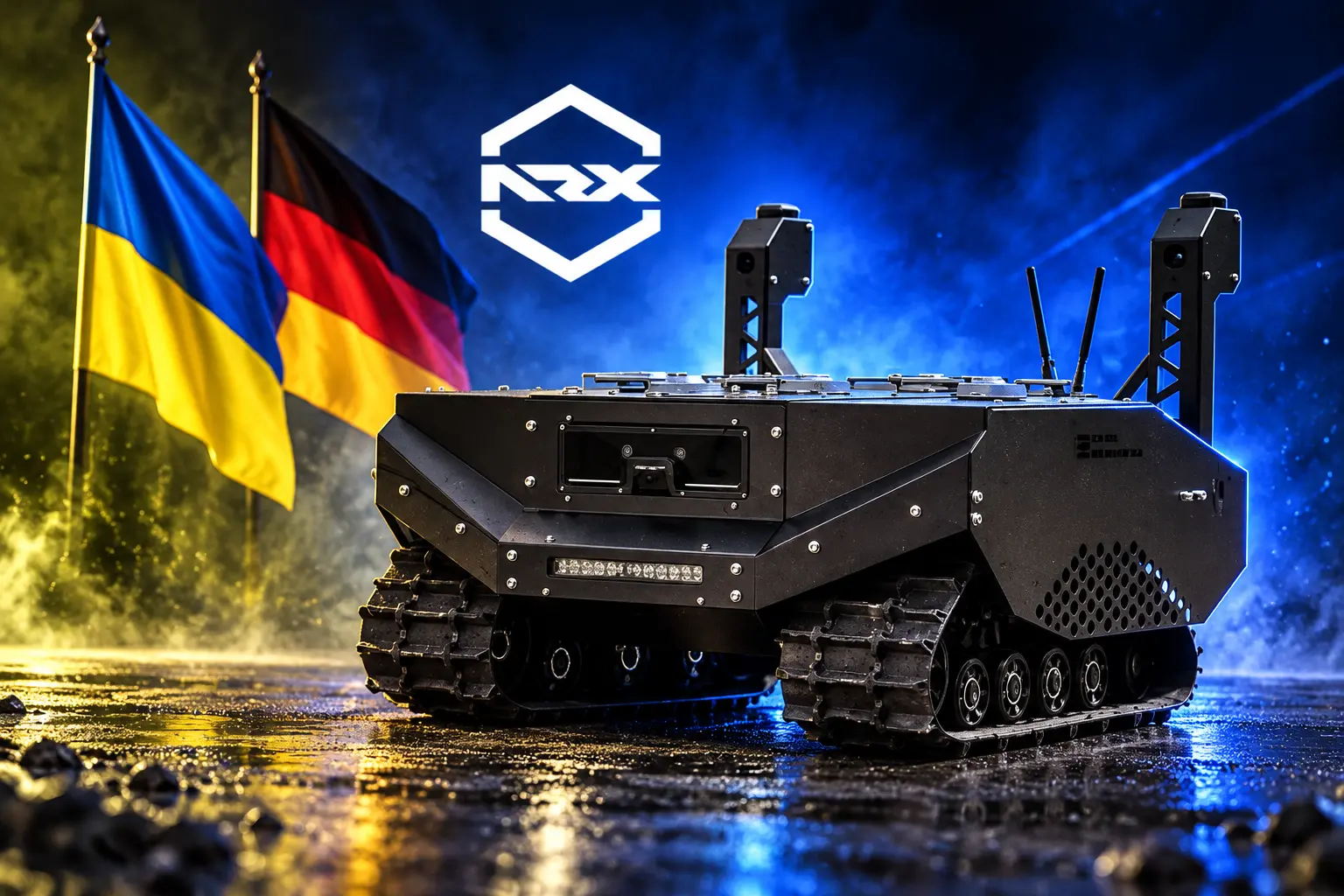
The partnership is not a merger of two identical machines. Gereon is ARX’s tracked, software-defined crawler. Rys Pro is Roboneers’ modular platform, already used for supply runs, casualty hauls and assault support. The Kyiv paper is supposed to make those systems talk to each other. The hardware still does different jobs.
GEREON AND RYS PRO AT A GLANCE
| Platform | Maker | Payload | Range | What it is for |
|---|---|---|---|---|
| Gereon RCS | ARX Robotics | Up to 500 kg | 40 km | Tracked logistics, medevac, modular combat |
| Rys Pro | Roboneers | Up to 300 kg | 40 km, 80 km with four batteries | Wheeled supply, evacuation, assault with a turret |
ARX publishes GEREON’s 500 kg payload alongside a 40 km travel range, 72 hours of operating time and a top speed of 15 km/h. Control range is up to 4 km. Charging takes 2.5 hours. The hull is built to swap payloads without tools and to run in teleoperated or autonomous modes, with thermal night vision and all-terrain tracks.
Roboneers says Rys Pro carries up to 300 kg of ammunition, water, food and kit, and can take stretchers. A May update raised its range to 40 km, with 80 km available if four batteries ride along. The same hull takes electronic-warfare packs and combat modules. In September the firm codified ShaRys PRO Mk.19 (M), pairing Rys Pro with a Shablya turret and a 40 mm automatic grenade launcher for fire out to 1,500 m, run by two operators. Roboneers also sells the Saber remote weapon station for unmanned hulls, pickups and other vehicles. The company says its platforms have been combat-validated in over 15,000 front-line missions since 2014.
Ulm Built the First Gereons in 12 Weeks
If Roboneers brings combat hours, DEUTZ brings a factory floor. The Cologne engine maker, founded in 1864, employs about 6,000 people and posted just over €2.0 billion in revenue in 2025. ARX and DEUTZ signed a strategic partnership in October 2025. On July 7, 2026, DEUTZ said it was launching industrial series production at the Ulm plant, with first Ukraine deliveries due from late summer.
On September 29, ARX and DEUTZ said the first Ulm-built Gereon systems had gone out, 12 weeks after that launch announcement. The batch is part of a larger contract and will join Gereon vehicles already in Ukraine. Production is due to rise over the coming months. Marco Herre, chief executive of DEUTZ’s Defense business unit, said the Ulm plant had shown it can make complex products quickly, reliably and at scale.
Wietfeld used the same delivery to argue that Europe’s armed forces need thousands of unmanned ground systems in a short window, and that the open question is how fast new machines move from development into use. DEUTZ is also wiring its drives, battery-electric now, smaller combustion or hybrid later, into ARX’s Mithra OS software, and it will put generators, storage and swap batteries into the field through its Energy and NewTech units.
That is the German answer to wartime tempo: drop a startup hull onto an engine line that already knows series work. Øystein Bogen, a security policy analyst, put the counter on the table after the Ulm photos landed. Ukraine, he said, can produce this class of machine at less than 30 percent of the German price and test it in combat every day. Cost against value, in his view, will decide the next battlefield. Ulm proves a line can move. It does not prove the German robot is the cheap one.
Frontline Data Goes Into Western Land Systems
Wietfeld’s Kyiv line about other Western armies is not a new sales flourish. ARX, founded in 2022, now has 300 people in Munich, Berlin, London and Kyiv. It already says Gereon and Mithra OS are in use with several European armed forces. Mithra is the software that is supposed to make a tracked robot, a legacy fighting vehicle and a new unmanned wingman share a picture of the fight, take over-the-air updates, and move as a group.
The June joint venture described the same loop in factory language: operational knowledge from the front feeds each production cycle, and every new batch is meant to reflect the latest lessons from units that are already using the machines. Igor Kornilov, chief executive of ARX Robotics Ukraine, said the firm’s close work with Ukraine’s defence forces lets it act on front-line feedback at speed. The October pact is that loop written into a technology partnership, with political cover from Merz and Zelenskyy in the same room.
WHERE THE WESTERN LOOP ALREADY SHOWS
- European fleets: ARX says its systems are deployed with several European armed forces, not only in Ukraine.
- UK trial path: ARX Robotics UK and General Dynamics Land Systems-UK are exploring an autonomous wingman fit for Ajax.
- Software on old steel: Mithra OS is sold as a way to put autonomy and sensors on vehicles armies already own.
- Drive and power: DEUTZ is building an interface from Mithra OS to its motors and field power kit, which is how a robot line uses an engine company’s service net.
Build with Ukraine, the German-Ukrainian banner over the June deal, is the political name for that bargain. Ukraine gets volume closer to the front. German industry gets a combat laboratory it cannot run at home. Western staff colleges get software written against a war in which, as Wietfeld put it, every action can be seen by the enemy.
Tens of Thousands a Year Remains a Target
On the same Kyiv visit, Merz also backed German funding for tens of thousands of interceptor drones from Quantum Systems, another German defence-tech firm that has now shown a ground vehicle of its own. The chancellor’s trip was a showcase for German unmanned industry, not a single-company errand. ARX still has to turn a technology pact into hulls.
FROM PARTNERSHIP TO THE KYIV SIGNING
- October 2025: ARX Robotics and DEUTZ sign a strategic partnership to scale unmanned ground systems.
- May 2026: ARX wins a contract for several hundred more Gereon vehicles and says the Ukraine fleet will be five times its initial size.
- June 25, 2026: In Gdańsk, the two firms form ARX Industries to mass-produce the Rys Pro in Germany and Ukraine.
- July 7, 2026: DEUTZ announces Gereon series production in Ulm, with first Ukraine deliveries from late summer.
- August 2026: ARX and Roboneers hand over 30 UGVs to a Ukrainian regiment for mixed logistics, evacuation and resupply work.
- September 29, 2026: The first Ulm-built Gereon systems are delivered, 12 weeks after the July launch notice.
- October 4, 2026: In Kyiv, with Merz and Zelenskyy present, the firms sign the technology partnership on integration and joint development.
ARX Industries still aims for several thousand Rys Pro vehicles in its first year and tens of thousands annually after that. Those figures are capacity talk, not a published delivery ledger. Gereon’s fivefold jump is several hundred more machines, not several thousand. The 30-unit handover is one regiment learning to run three jobs at once. Ukraine’s 50,000-unit year is a government target that a Munich startup, a Lviv robotics shop and an engine plant in Ulm have not yet shown they can fill on their own.
Frequently Asked Questions
What is the Gereon RCS ground vehicle?
Gereon RCS is ARX Robotics’ medium tracked unmanned hull, about 124 cm long and 134.8 cm wide without the antenna, and 65.7 cm high without antenna or payload. It is built to fit in standard military transport, swap mission kits without tools, and run with LiDAR, thermal and stereo cameras under GNSS-independent autonomy as well as remote control.
What is the Rys Pro and how is it armed?
Rys Pro is Roboneers’ modular ground robot for supply, casualty evacuation and assault support. The May 2026 kit adds MESH radios, LTE control, a rear camera and a Starlink Mini terminal as standard. The armed ShaRys PRO Mk.19 (M) fit, codified in September 2026, mounts a Shablya turret with a Ukrainian AGL-53 or Mk 19 40 mm grenade launcher; the unarmed hull is listed at 555 kg.
What is Mithra OS used for?
Mithra OS is ARX’s AI operating system for unmanned and manned land vehicles. It fuses sensors into a live picture, pushes over-the-air software updates, adds autonomy to older platforms, and is being piloted for grouped movement and manned-unmanned teaming. DEUTZ and ARX are also writing an interface so Mithra can command DEUTZ drives.
How much funding has ARX Robotics raised?
ARX said in 2025 that a Series A extension of €11 million, led by Speedinvest, took total funding to €42 million. Trending Topics later listed HV Capital, the NATO Innovation Fund and Speedinvest among its backers and noted expansions into Poland and Austria on top of Munich, Berlin, London and Kyiv.
Who manufactures the Rys Pro for ARX Industries?
ARX Industries is the June 25, 2026 joint venture between ARX Robotics and Roboneers, signed in Gdańsk at the Ukraine Recovery Conference in front of Deputy Defence Minister Sergiy Boyev and Ihor Fedirko of the Ukrainian Council of Defence Industry. The venture is supposed to handle manufacturing, maintenance and operational support at sites in Germany and Ukraine under the Build with Ukraine banner.
Ulm can build Gereon now, and Kyiv has tied that line to a Ukrainian robot that has already fought. The 50,000-unit year is still a government target, not a delivery note.

Nesta Finds a Baby Blind Spot in Scotland’s GIRFEC Promise

FDA Closes Cyclospora Lettuce Probe Without Proving How

Pixel Watch 5 Discount Erases Google’s $50 Launch Hike

Pokémon GO Halloween 2026 Locks Candy Behind a Pass

ARX Robotics and Roboneers Tie Ukraine Combat to Western Fleets

Where Can I Cash a Comcheck – What Are My Options?

Arm Bets Compute Subsystems Will Reach Physical AI

OpenAI Turns ChatGPT Into a $1 Billion Ad Auction

Coremail Pitches AI-Native Email Security at LEAP 2026

The Yen Rally Was Funded by a Record Reserve Sale
-
 LIFESTYLE3 years ago
Where Can I Cash a Comcheck – What Are My Options?
-
 NEWS1 month ago
Arm Bets Compute Subsystems Will Reach Physical AI
-
 BUSINESS1 month ago
OpenAI Turns ChatGPT Into a $1 Billion Ad Auction
-
 BUSINESS1 month ago
The Yen Rally Was Funded by a Record Reserve Sale
-
 NEWS1 month ago
Coremail Pitches AI-Native Email Security at LEAP 2026
-

 NEWS4 weeks ago
Gottheimer’s AI LABS Act Enters an Already Crowded Field
-

 TECHNOLOGY3 years ago
How Many Cards in a Uno Deck – What’s the Exact Number?
-

 BUSINESS1 month ago
Ostrich Farms Rebuild Around a Tick-Bite Meat Allergy