
LIFESTYLE
Was Benjamin Franklin a US President?
Was Benjamin Franklin a US president? No. He led Pennsylvania’s council from 1785 to 1788, and Washington took the first national oath on April 30, 1789.

You know his face from the largest bill in a cash drawer, and you know his name from every short list of founders. That pairing is why the question keeps coming back. Was Benjamin Franklin a US president? He never held the national office, and he never ran for it.
The word president was already attached to work he did, above all the chief post in Pennsylvania. Those titles are easy to mix up with the national office, which began only when the Constitution’s government started. This page sorts the titles, dates that national office, and names the public work he did without it.
What Did President Mean Before 1789?
In Franklin’s lifetime, president usually meant the person chosen to preside. A council, an assembly, or a learned society could all have a president, and the word named the chair, not a rank above the states. Pennsylvania’s first state constitution used it for the head of an executive council. Private groups used the same word for the member who led their meetings.
The national meaning arrives with the Constitution. The first person to swear that oath is George Washington, in New York. Washington’s first inaugural address on April 30, 1789 is the start of the office people mean when they ask the question. Franklin was alive that day. He was not the man taking the oath.
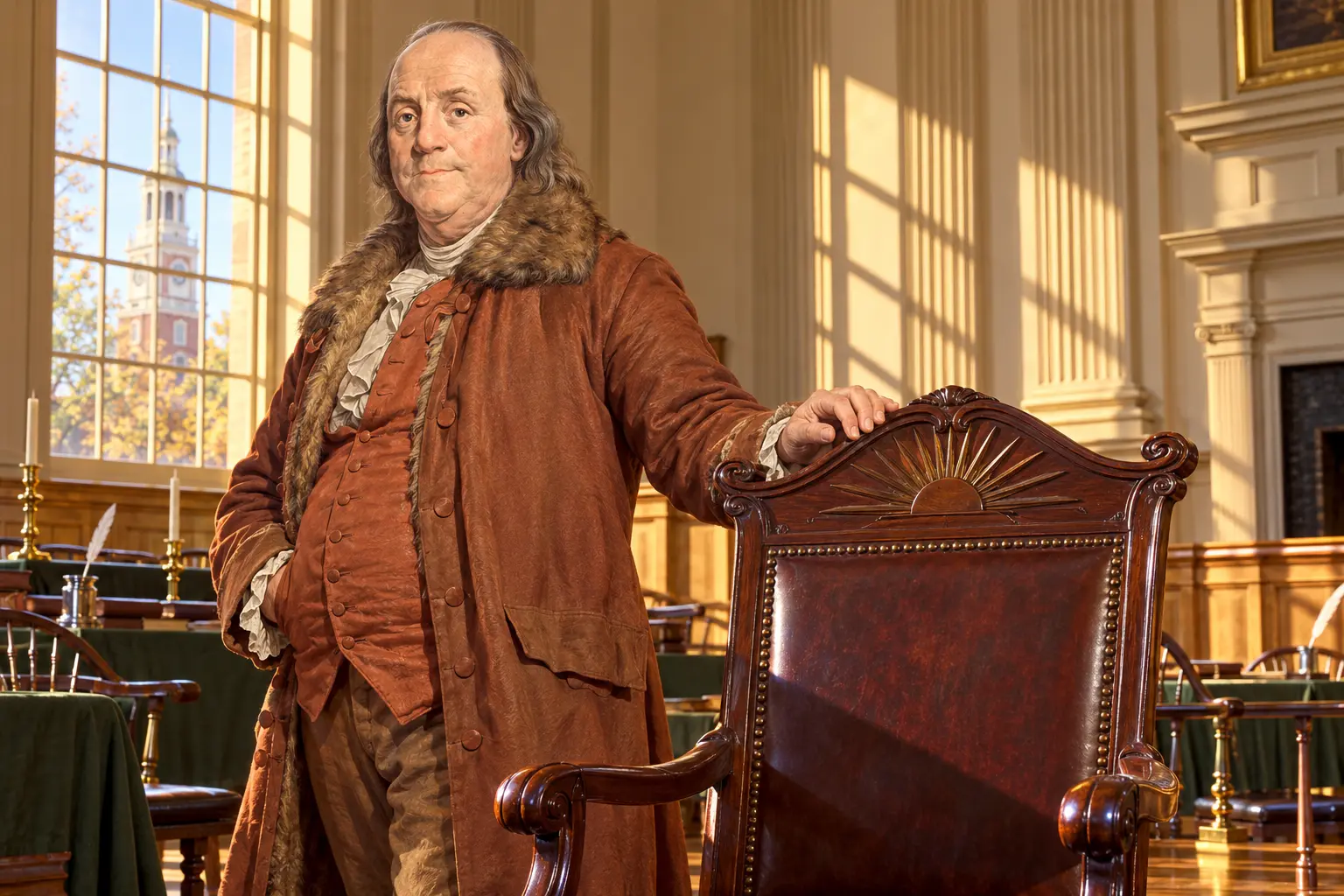
Franklin as President of Pennsylvania
The title that causes the mix-up is real, and it is state business. On his return from France, the council elected him unanimously as president of the Supreme Executive Council of Pennsylvania. He was 79. His name is on the roll of presidents of Pennsylvania’s executive council.
That office is the one a governor fills now. Pennsylvania did not call him governor, because that constitution did not put a single governor at the head of the state. A president and a vice president led the council. He was reelected, and papers from those years address him as president of the council. When an old document says President Franklin, this is the job it means.
FRANKLIN’S PRESIDENT TITLES
| Office | When | What the title covered |
|---|---|---|
| President of the Supreme Executive Council of Pennsylvania | October 18, 1785 to October 14, 1788 | Chief executive of Pennsylvania, the work a governor does now |
| President of the American Philosophical Society | From the 1769 union of the society, renewed each year until his death | Head of the learned society he founded in 1743 |
| President of the Pennsylvania Anti-Slavery Society | From 1787 | Head of a private abolition group, not a government |
The state constitution barred more than three successive years in that presidency, which is why his name leaves the list when the term is up. The philosophical society and the abolition group used the same word for a private chair. In earlier years he had owned enslaved people and had printed advertisements for slave sales in his newspapers. Chairing the anti-slavery society was a public break with that record.
The National Office Washington Took
By the time electors chose a national president, Franklin was past any realistic campaign. He was 83 by the inauguration, ill with gout and a kidney stone, and already unable to stand through his own speeches. The election went to Washington, who had presided over the Convention that wrote the office.
Franklin died in Philadelphia on April 17, 1790, less than a year after that oath. He had lived to see the office filled. He never occupied it, and no count of presidents inserts him ahead of Washington or beside him. The line starts with the New York oath.
What Franklin Signed, Negotiated, and Ran
His name sits with the presidents because of the work, not the chair. Born in Boston on January 17, 1706, he was apprenticed at twelve to his brother James, a printer. He left for Philadelphia in 1723, spent a stretch in London, and came home to build a printing house, a newspaper, and an almanac with his wife Deborah.
The public posts sat on institutions he had already started in that city. He helped found a lending library, a volunteer fire company, a hospital, and the academy that became the University of Pennsylvania, and he founded the American Philosophical Society. The president titles came after that civic groundwork. They did not replace a missing career.
The Declaration Line He Rewrote
When the break with Britain came, Congress placed him on the Committee of Five that drafted the Declaration of Independence. Thomas Jefferson did most of the writing. Franklin’s best-known edit is a small swap with a large effect, and the record kept at Mount Vernon credits him with it.
THE LINE HE CHANGED
- Jefferson’s draft: The opening truths are sacred and undeniable.
- Franklin’s wording: The truths are self-evident.
The change grounds those rights in reason rather than in a claim of holy certainty. Mount Vernon also calls him the only man to sign the Declaration of Independence, the Treaty of Paris, and the Constitution. He signed the 1778 Treaty of Alliance with France as well, the page that brought French ships, troops, and money into the war.
France and the Post Office
Congress sent him to France in 1776, and he stayed through the victory and the peace, returning in 1785. Paris already knew him from electrical experiments, the kite trial, and the lightning rod, so salons treated a colonial agent as a celebrity before they treated him as a diplomat. The alliance followed. So did the talks that produced the Treaty of Paris.
- July 26, 1775: The Continental Congress names him postmaster general, the first person on that list.
- November 7, 1776: His son-in-law, Richard Bache, is appointed to follow him as Franklin leaves for France.
- 1776 to 1785: He serves in France, signs the alliance and the peace, and comes home to the Pennsylvania council.
The Postal Service still opens its historical list with him as Postmaster General on July 26, 1775. He had already run the colonial post under the British crown, so the congressional appointment was a return to a system he knew, timed to a country that was about to need its own mail.
The Convention Speech He Could Not Read
Pennsylvania sent him to the Constitutional Convention in Philadelphia, and he was the oldest delegate in the room. During those weeks he was also still the state’s president, so the building held two different presidents at once. Washington occupied the chair. Franklin sat with the Pennsylvania delegation.
On the closing day of the Convention, September 17, 1787, gout and a kidney stone kept him from reading his own appeal. James Wilson of Pennsylvania read it. The speech asks doubtful delegates to sign anyway, so the new government can start with one public face rather than a visible split.
As the last names went on the page, he looked at the chair Washington had used. A sun is carved on the back. His remark, preserved in the notes, is that he had often looked at that sun without knowing whether it was rising or setting, and that he at last knew it was rising. Outside the hall, Elizabeth Willing Powel asks whether the delegates have produced a republic or a monarchy. His answer is the line people still repeat: “A republic, if you can keep it.”
Washington, not Franklin, was president of that meeting. The carved chair belonged to the man who would later take the national oath. Franklin signed the Constitution as a Pennsylvania delegate and then urged his state toward ratification.
Why Is Franklin on the Hundred Dollar Bill?
The bill is the other reason people award him a presidency he did not hold. The largest note in ordinary use carries his portrait, and most of the other faces in a wallet belong to presidents. You can compare them on the official list of portraits on the seven current notes.
| Note | Person on the front | How the currency program labels that person |
|---|---|---|
| $1 | George Washington | President |
| $2 | Thomas Jefferson | President |
| $5 | Abraham Lincoln | President |
| $10 | Alexander Hamilton | Treasury secretary |
| $20 | Andrew Jackson | President |
| $50 | Ulysses S. Grant | President |
| $100 | Benjamin Franklin | Named on his own, with Independence Hall on the back |
Hamilton is the other person on those notes who was not a president. Franklin’s note shows Independence Hall on the back, the Philadelphia building where he sat in the Convention and where the state council met. The portrait honors the printer, the diplomat, and the civic founder. It does not certify a term.
How to Check a Franklin President Claim
A confident line in a quiz, a caption, or a family argument still needs three checks. They take less time than the argument, and each one points at a record you can open.
- Name the office. President of Pennsylvania, president of a society, and President of the United States are different jobs. A paper from the 1780s that says President Franklin means the state council.
- Put a date on it. Any title dated before Washington’s oath on April 30, 1789 cannot be the national presidency. Franklin’s Pennsylvania service ends in October 1788, months before that oath.
- Set the portrait aside. A face on money, a statue, or a list of founders is a mark of fame. It does not add a term to the presidential line.
If a source calls him president of the Continental Congress, treat that as a miss. He sat in Congress as a Pennsylvania delegate and served on the committee that drafted the Declaration. The presiding chair of Congress was a separate office, and it is not among the posts listed for him at Mount Vernon or on the Pennsylvania council roll.
Frequently Asked Questions
Where Is Benjamin Franklin Buried?
He is buried at Christ Church cemetery in Philadelphia, the city where he printed his newspaper, led the state council, and died at home. The stone marks a long Philadelphia life, not a term in the national presidency.
Who Followed Franklin as President of Pennsylvania?
Thomas Mifflin followed him as president of the council after a brief gap filled by Vice President David Redick. The council system itself ended in 1790, after Franklin had already died, and the state then used a single governor.
Are Older Hundred Dollar Bills With Franklin Still Spendable?
Yes. Every design of US currency remains legal tender no matter when it was printed, so an older hundred with Franklin on it still spends. Later notes added a watermark, a security thread, and color-shifting ink around the same portrait.
Did Franklin Want a Single National Executive?
No. During the Convention he had a speech read that warned a single executive could pull the country toward a monarchy, and he asked for a small group of men to share the work of seeing that the laws were carried out. The delegates set that idea aside and kept one president.
Which Birthday Should You Use for Benjamin Franklin?
Use January 17, 1706. That is the date on the calendar Britain and the colonies adopted in 1752. Before that change, his birthday was written as January 6, and both wordings refer to the same day in his life.
The next time the question comes up, match the office to the year. A president title on Franklin before Washington’s oath belongs to Pennsylvania or to a society. The national line starts with the man who swore that oath in New York, and Franklin’s name stays on the documents, the mail, and the hundred-dollar note.

Nesta Finds a Baby Blind Spot in Scotland’s GIRFEC Promise

FDA Closes Cyclospora Lettuce Probe Without Proving How

Pixel Watch 5 Discount Erases Google’s $50 Launch Hike

Pokémon GO Halloween 2026 Locks Candy Behind a Pass

ARX Robotics and Roboneers Tie Ukraine Combat to Western Fleets
Nesta Finds a Baby Blind Spot in Scotland’s GIRFEC Promise

OpenAI Turns ChatGPT Into a $1 Billion Ad Auction

Where to Cash a Comcheck: What to Do Before the Counter

Gottheimer’s AI LABS Act Enters an Already Crowded Field

Ostrich Farms Rebuild Around a Tick-Bite Meat Allergy
-
 BUSINESS3 months ago
OpenAI Turns ChatGPT Into a $1 Billion Ad Auction
-
 LIFESTYLE1 month ago
Nesta Finds a Baby Blind Spot in Scotland’s GIRFEC Promise
-
 NEWS2 months ago
Gottheimer’s AI LABS Act Enters an Already Crowded Field
-
 BUSINESS3 years ago
Where to Cash a Comcheck: What to Do Before the Counter
-
 BUSINESS2 months ago
Ostrich Farms Rebuild Around a Tick-Bite Meat Allergy
-
 BUSINESS2 months ago
The Yen Rally Was Funded by a Record Reserve Sale
-

 SCIENCE3 years ago
Where to Get a Mantoux Test: Clinics That Place and Read It
-

 NEWS2 months ago
Arm Bets Compute Subsystems Will Reach Physical AI