
SCIENCE
Where to Get a Mantoux Test: Clinics That Place and Read It
A Mantoux test counts only if the same clinic can read the firm spot 48 to 72 hours later. Here is where to go, what to ask, and how the result is judged.

Job forms, school forms, and medicine checks use three names for one skin test: Mantoux, PPD, and TB skin test. The test looks for tuberculosis germs by how your skin reacts to a fluid called tuberculin, also called purified protein derivative.
You need two visits with a trained person, one to place that fluid under the skin of your inner forearm and one to measure the spot two or three days later. If you miss the return visit, the clinic has to place the test again, so the first trip does not finish the job.
Start with your own clinician, or with your state or local TB program if you do not have one. Before anyone injects the fluid, confirm that the site will test you for the reason on your form and will be open when the spot has to be measured. The rest of this guide covers which sites do that, what to ask on the phone, how the two visits work, and when a blood test is the booking you want.
Mantoux Test Sites You Can Call First
There is no single national Mantoux clinic. In the United States, testing sits with health departments and with ordinary medical offices, and the CDC list of state TB programs names a program for every state plus several large cities. Call that program if you are not sure which local clinic places a skin test. Outside the United States, the local public health unit is the same starting door.
Public and private health plans may cover the test. What you pay if they do not is set by the clinic, not by a national fee chart. Salt Lake County posts a skin-test fee of $25 and does not bill insurance for it, which shows a county clinic that will test the public and still charge.
The kind of site matters as much as the address. Some TB clinics exist to find infection after an exposure or before a medicine that weakens immunity, and they turn away a form that is only for a job or a class. Match your reason to the site before you take time off work.
| Place | Skin-test visits | What to confirm |
|---|---|---|
| Health department or TB clinic | Two, if they place skin tests | Whether they test for exposure and medical needs only, or also for work and school |
| Your own clinician | Two | That you can return to the same office for the reading |
| Retail or pharmacy clinic | Two | The return slot, and whether a blood test is available if your form allows it |
| Urgent care | Two | That the clinic is open on the day your reading window falls, including a weekend day |
| Community health center or tribal clinic | Two, if the site offers the test | That they both place and read a Mantoux test, and what the fee is |
| Employer, school, or occupational clinic | Two, or four for a two-step series | Whether the form names Mantoux or PPD, or will take a blood test |
New York City chest centers show how narrow a public clinic can be. They offer low-cost or no-cost TB care without asking about immigration status or requiring insurance, and they require an appointment. Testing for work or school is not part of that service. The city sends those forms to community clinics and public hospitals.
The same split shows up elsewhere. The Windsor-Essex County Health Unit in Ontario does not offer a skin test for school, a job, or volunteering. It does offer a free test if you are a contact of someone with active TB disease, or if you need the test for a medical reason, such as before certain medicines. Alberta public health centres send work and travel testing to travel health services, and they state that a Mantoux test is not the test used to diagnose active TB disease. Free testing there depends on the site’s eligibility rules.
Community health centers, some pharmacies, and tribal or urban Indian clinics are the other public doors. A Washington State Department of Health page tells residents to ask their own clinician first, then a community health center, a low-cost clinic, some pharmacies, a tribal clinic, or the local health department. A listing that says TB testing can mean a blood draw only, so call before you go.
Questions to Ask Before You Book
A yes on the phone is not enough unless it covers the return visit. A skin test has to be read 48 to 72 hours after it is placed, which is two or three days later. Count both ends on a calendar before you accept a slot.
A Monday placement can be read on Wednesday, at 48 hours, or on Thursday, at 72 hours. A Friday placement can be read on Sunday, at 48 hours, or on Monday, at 72 hours. A Thursday placement lands at 48 hours on Saturday and at 72 hours on Sunday. If the clinic is closed on both days inside your window, ask for a different placement day.
Salt Lake County books skin-test placements only on Monday, Tuesday, Wednesday, and Friday so the read can land while the clinic can see you. Salt Lake County’s TB clinic page spells out that calendar. Blood tests there run on weekday hours because a blood sample does not need a second visit for a reading.
ASK THESE BEFORE YOU BOOK
- The test: Do you place a Mantoux or PPD skin test, draw a TB blood test, or do both?
- Your reason: Do you test people for work, school, volunteer hours, travel, or a new medicine, or only after an exposure?
- The read: On what day and at what time will a trained person measure the spot, and are you open then?
- The record: Will I leave with the size in millimeters on a form my job or school accepts?
- A second test: If this is a first test for health care work, do I need a two-step series rather than one placement?
Write the answers next to the appointment. A return visit for nursing school or a hospital job can mean a stop in an urgent care waiting room, among patients who came in sick, so the spot can be measured. If the clinic can place the test but cannot see you again inside the window, book a different site before anyone opens a vial.
How Is a Mantoux Test Placed?
When those answers check out, the first visit is the placement. Only a designated, trained health worker should place and read the test, and state or local public health rules decide who is allowed to do it. You should not place this test on yourself, and a friend should not measure it for a form.
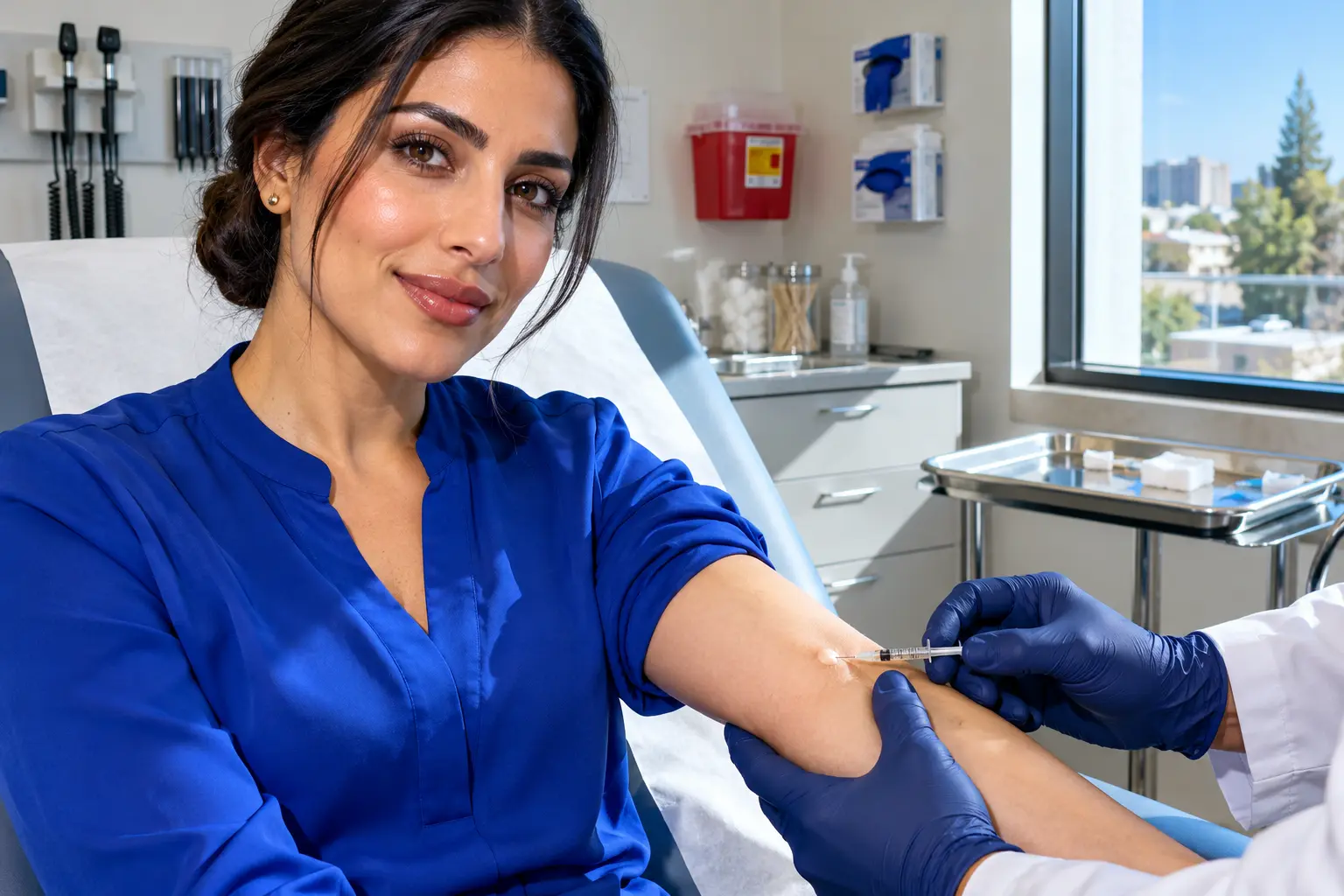
The worker injects tuberculin into the top layer of skin on the inner forearm. A correct placement raises a pale bump, called a wheal, that you can see before you leave the chair. If the dose is wrong, or the fluid goes too deep and no wheal forms, that test does not count and has to be repeated at a new spot.
These are the checks that show the placement followed the standard method.
- You rest your forearm palm-up, and the worker picks a clear patch of skin on the inner arm.
- A disposable 27-gauge tuberculin syringe delivers 0.1 ml with the bevel up, at a 5 to 15 degree angle.
- A correct injection raises a pale wheal 6 to 10 mm across. If it does not, the test is repeated at least 2 inches from the first spot.
- You leave with a return time and, if the clinic records them, the date, the arm used, and the lot number of the vial.
You can watch a CDC training video of a provider placing the fluid and later measuring the firm spot. Seeing the wheal once makes a failed placement obvious.
Most people can have this test, including infants, children, pregnant women, and people with HIV. It should not be done if an earlier skin test caused a severe reaction, such as necrosis, blistering, ulcerations, or anaphylactic shock. It also should not be placed if you already have a written positive result from a skin test or a blood test, or if you were treated for TB disease. Tell the clinic about any live vaccine you had this month. The timing rule for those shots is in the questions at the end.
Reading a Mantoux Test at 48 to 72 Hours
The placement visit only starts the test. You go back inside that same 48 to 72 hour window. A trained worker looks at the site in good light, feels for firm swelling, and ignores the redness around it. Red skin is not the result.
The worker measures the firm swelling across the forearm, not along the length of the arm, and writes the number in millimeters. No firm swelling is recorded as 0 mm. Ask for that number on your copy. A sheet that says only negative is harder to use later, because the cutoff is not the same for every person.
The size that counts as positive depends on your chance of TB infection and on your chance of getting sick if you are infected. The groups below are the ones named in CDC clinical guidance on the skin test.
| Firm swelling counted as positive | Who is in this group |
|---|---|
| 5 millimeters or more | People with HIV; recent contacts of someone with infectious TB disease; people whose chest x-ray suggests earlier TB disease; organ transplant recipients; and other people on strong immune-suppressing treatment, including prolonged corticosteroids at or above 15 mg a day of prednisone, or TNF-alpha antagonists |
| 10 millimeters or more | People born in countries where TB disease is common, including some countries in Asia, Africa, and Latin America; people who misuse drugs or alcohol; people who live or work in nursing homes, homeless shelters, or correctional facilities; mycobacteriology laboratory workers; people with silicosis, diabetes, severe kidney disease, certain cancers, or certain intestinal conditions; people under 90% of ideal body weight; children younger than 5; and infants, children, and adolescents exposed to adults in the higher-risk groups |
| 15 millimeters or more | People with no known risk factors for TB |
A CDC wall chart adds one hiring rule on top of those groups. An employee who is otherwise at low risk, and who is tested at the start of a job as part of an infection-control program, is counted as positive at 15 millimeters or more.
The test cannot see a brand-new infection on the day you are exposed. It takes 2 to 8 weeks after the first infection for the immune system to react to the fluid. If you were exposed this week, ask when to test again rather than treating today’s result as the last word.
A Blood Test Instead of a Mantoux Test
A blood test answers the same question, whether TB germs are in your body, with one draw and no return visit. Current guidelines prefer a TB blood test for most people. A skin test remains an accepted stand-in when a blood test is not on hand, costs too much, or is too hard to arrange. The blood tests used in the United States are QuantiFERON-TB Gold Plus and the T-SPOT.TB test.
Read the form before you skip the skin test. If it prints the words Mantoux or PPD, ask the program whether a blood result is accepted. Retail clinics are a common path when the form will only take a skin test. The MinuteClinic tuberculosis testing page says its providers mainly place the skin test and see you again within 48 to 72 hours, and it names QuantiFERON-TB Gold as a blood-test option. Most insurance is accepted there, and the price depends on the visit.
The BCG Vaccine and a Mantoux Test
BCG is a tuberculosis vaccine given to infants and young children in countries where TB is common. It is not a routine vaccine in the United States. It can make a skin test turn positive even when you do not have TB germs, and there is no sure way to separate a BCG reaction from true infection on the skin test alone.
Tell the clinic if you had BCG. A blood test is the preferred test after BCG, including for children who received it, because BCG does not make those blood tests positive. If a skin test is used anyway, the result is still read by your risk group.
BRING THIS UP AT THE DESK
- Your vaccine: Say whether you received BCG, and about when, before anyone chooses the test.
- The form: If the form allows either test, book the blood test.
- A skin test anyway: A positive skin test after BCG still needs a check for inactive infection or TB disease.
Repeated skin tests can also keep a BCG reaction going. People who were vaccinated and then tested again and again can stay reactive longer than the vaccine effect would have lasted on its own.
A Two-Step Mantoux Test for Health Care Work
Some people who were infected long ago barely react the first time they are tested years later. The first test wakes the immune response, and a second test then turns positive. That second result is an old infection showing itself, not a new one caught between the two dates. Two-step testing keeps that old reaction from being logged later as a fresh infection.
Use a two-step series for the first skin test of someone who will be retested on a schedule. When a skin test is the baseline check for U.S. health care personnel, two-step testing is the method to use.
- The first test is placed and then read two or three days later.
- If that result is positive, skin testing stops and the next step is a check for inactive infection or TB disease.
- If the first result is negative, a second test is placed one to three weeks after the first test is read.
- The second test is read two or three days after that placement. A positive second test is classed as an earlier infection. A negative second test means the baseline is negative.
Count the trips before you pick a site with short hours. A two-step series is four stops when each placement and each reading is its own visit, spread across a few weeks. A blood test does not use this pair of skin tests, and it does not boost the next result the way a skin test can.
A Mantoux Test for Children Under 5
For a child younger than 5, the named method is the skin test. Some experts still use a blood test at that age. A school form for an older child is a different booking, and many of those forms follow the adult choice between skin and blood.
A few situations still point an adult back to the skin test:
- The blood test is not offered near you, or the sample cannot get to a lab in time.
- The blood test costs more than you can pay, and a health department will place the skin test.
- The form names Mantoux or PPD and will not take a blood result.
Bring the child’s vaccine record, including BCG if it was given, and any note of a past severe reaction. A parent measuring the spot at home does not produce a result a school can file. The reading still has to come from a trained worker.
After a Positive Mantoux Test or a Missed Read
A result on paper still leaves two loose ends: a positive test that is not yet a diagnosis, and a reading you missed. A positive result means TB germs are in your body. It does not sort inactive infection, also called latent TB, from active TB disease. More testing can include a chest x-ray and a check of the sputum you cough up. Your clinician then talks through treatment.
Ask for a written record of the positive result and the millimeter size. Most people who have a positive result will still test positive later, including after they finish treatment for inactive infection or for TB disease. That sheet is what you show the next time a job asks for a test.
A negative result means inactive infection or active disease is unlikely. More testing still makes sense if you have symptoms, if you have HIV, or if you were around someone with infectious TB recently. Do not wait out the skin-test window to report a cough, chest pain, fever, weight loss, or tiredness. Those symptoms are a reason to start other checks now.
If you do not return within 72 hours, the test is placed again. Repeating a skin test is allowed unless a past test caused a severe reaction. Repeated placements can boost a later result, which is the memory effect the two-step series is built to catch. Book the repeat as a new pair of visits, not as a late reading of the old spot.
Frequently Asked Questions
Can You Get a Mantoux Test on the Same Day as a Live Vaccine?
You can have a Mantoux test on the same day as a live-virus vaccine. If the test is not done that same day, wait at least one month after measles, mumps, rubella, oral polio, varicella, or yellow fever vaccine. A vaccine made from inactivated virus does not interfere with the skin test. A COVID-19 vaccination should not be delayed because you need a TB test, and the skin test can be done before, during, or after that shot.
Should You Cover a Mantoux Test With a Bandage?
Leave the spot uncovered. A British Columbia Centre for Disease Control training video tells patients not to put a bandage on the site, and it tells them to stay in the clinic for 15 minutes after the injection in case of a reaction. The same video calls mild itching, swelling, or irritation a normal reaction and says it settles within one week.
What Should You Bring to a Mantoux Test Visit?
Bring the form that asks for the test and any written record of an earlier TB result. Tell the person placing the test if you received a BCG vaccine, a recent live vaccine, or a severe reaction to an earlier skin test. The vaccine history changes which test the clinic should use, and a severe past reaction is a reason to switch to a blood test.
Can You Get a Mantoux Test While Pregnant?
Yes, you can get a Mantoux test while pregnant. A TB blood test is safe during pregnancy. Those blood tests have not been evaluated for diagnosing inactive TB in pregnant women, so your clinician still picks which test to use.
What If You Already Have a Written Positive Result?
Do not have another Mantoux test if you already hold a written positive result from a skin test or a blood test, or if you were treated for TB disease. Most people who have tested positive will test positive again, and another skin test will probably not add to your care. If a new form still demands a test, ask the program to accept the old record, a blood test, or a chest x-ray instead of a fresh skin test.
Put the reading appointment on the calendar before you walk out of the placement visit, and keep the millimeter result with your other medical papers. If that result is positive, the next clinic needs the sheet more than it needs another injection.
Disclaimer: This guide is for education only and does not diagnose tuberculosis or tell you which result applies to you. It is not medical advice, and it is not a substitute for care from a clinician or a public health department. Talk with a qualified clinician or your local TB program before you book a test, especially if you have symptoms, a weak immune system, or a record of a past positive result. Fees, clinic rules, and testing guidance reflect the sources reviewed for this page and can change.

Nesta Finds a Baby Blind Spot in Scotland’s GIRFEC Promise

FDA Closes Cyclospora Lettuce Probe Without Proving How

Pixel Watch 5 Discount Erases Google’s $50 Launch Hike

Pokémon GO Halloween 2026 Locks Candy Behind a Pass

ARX Robotics and Roboneers Tie Ukraine Combat to Western Fleets

OpenAI Turns ChatGPT Into a $1 Billion Ad Auction

Where to Cash a Comcheck: What to Do Before the Counter

The Yen Rally Was Funded by a Record Reserve Sale

Ostrich Farms Rebuild Around a Tick-Bite Meat Allergy

Where to Get a Mantoux Test: Clinics That Place and Read It
-
 BUSINESS2 months ago
OpenAI Turns ChatGPT Into a $1 Billion Ad Auction
-
 BUSINESS2 months ago
The Yen Rally Was Funded by a Record Reserve Sale
-
 BUSINESS3 years ago
Where to Cash a Comcheck: What to Do Before the Counter
-
 BUSINESS2 months ago
Ostrich Farms Rebuild Around a Tick-Bite Meat Allergy
-

 NEWS2 months ago
Coremail Pitches AI-Native Email Security at LEAP 2026
-

 NEWS2 months ago
Gottheimer’s AI LABS Act Enters an Already Crowded Field
-

 NEWS2 months ago
Arm Bets Compute Subsystems Will Reach Physical AI
-

 ENTERTAINMENT3 years ago
What Is the Setting of a Story? Elements of Literary Settings