
NEWS
IonQ Prices a 25.7-Day Break of Bitcoin’s Curve
IonQ’s paper times a 25.7-day break of Bitcoin’s curve, while CEO Niccolo de Masi sells Superion machines and quantum-safe networks on the same clock.

IonQ priced a 25.7-day break of Bitcoin’s curve on September 8, then sent CEO Niccolo de Masi to talk computers, AI, and cyber defense. He sat with host Morgan Brennan the next morning after Investor Day at the New York Stock Exchange.
The company had just published a resource estimate for Shor’s algorithm against secp256k1, opened orders on a 256-qubit rack called Superion, and signed an $8.18 million quantum-safe network deal. The same packet raised 2026 sales guidance by folding in a chip foundry.
IonQ Puts Bitcoin’s Curve on a 25.7-Day Clock
The fully compiled Shor’s algorithm estimate is the number de Masi carried into the Brennan interview. IonQ’s research team mapped the elliptic-curve discrete logarithm problem onto its Walking Cat trapped-ion design, then counted the physical hardware a full run would need.
The paper’s working figures are 19,397 physical qubits and 25.7 days per attempt against secp256k1, the 256-bit curve used by Bitcoin and by a thick layer of internet signatures. At the logical layer the same job is 1,457 qubits and 39 million Toffoli gates. IonQ lined that footprint up with machines it says belong on the 2028 stretch of its public roadmap.
THE SECP256K1 RESOURCE ESTIMATE
| Measure | IonQ figure |
|---|---|
| Physical qubits | 19,397 |
| Time per attempt | 25.7 days |
| Logical qubits | 1,457 |
| Logical Toffoli gates | 39 million |
| Stated hardware window | 2028 timeframe |
Chris Ballance, president of quantum computing, said the accounting is the point. Prior public estimates often skip the error-correction work that eats most of a real clock. This one, he said, does not.
This is the first time anyone has taken a utility-scale quantum algorithm and estimated its cost without approximating away the parts that usually dominate a real machine’s runtime. We compiled every operation down to the actual error-correction primitives our architecture runs. Today’s paper proved rather than assumed a lower bound on the probability that the full computation succeeds. It should be noted that no deployed digital asset nor crypto platform was affected during IonQ’s research.
Chris Ballance, President of Quantum Computing, IonQ, September 8 statement
De Masi used the same release to reopen a claim he first made in 2025, that Q-Day, the point when a quantum machine can break widely used public-key crypto, was moving out of the 2030s and into the 2020s. He said large companies and the U.S. government now agree, and he pointed to a White House order on quantum security signed in June. Martin Roetteler, vice president of quantum applications research, said a job that once wanted millions of physical qubits now fits on a 20,000-qubit-class IonQ machine on that roadmap. The paper’s own table keeps the tighter count of 19,397.
IonQ shared advance copies with U.S. government and industry partners before publishing, and it withheld the specific circuits. Jordan Shapiro, president of the quantum platform, called the work a capability milestone first and a security finding second. That is a careful label for a document whose headline still names Bitcoin’s curve.
Superion 256 Is Meant to Leave the Lab as a Rack
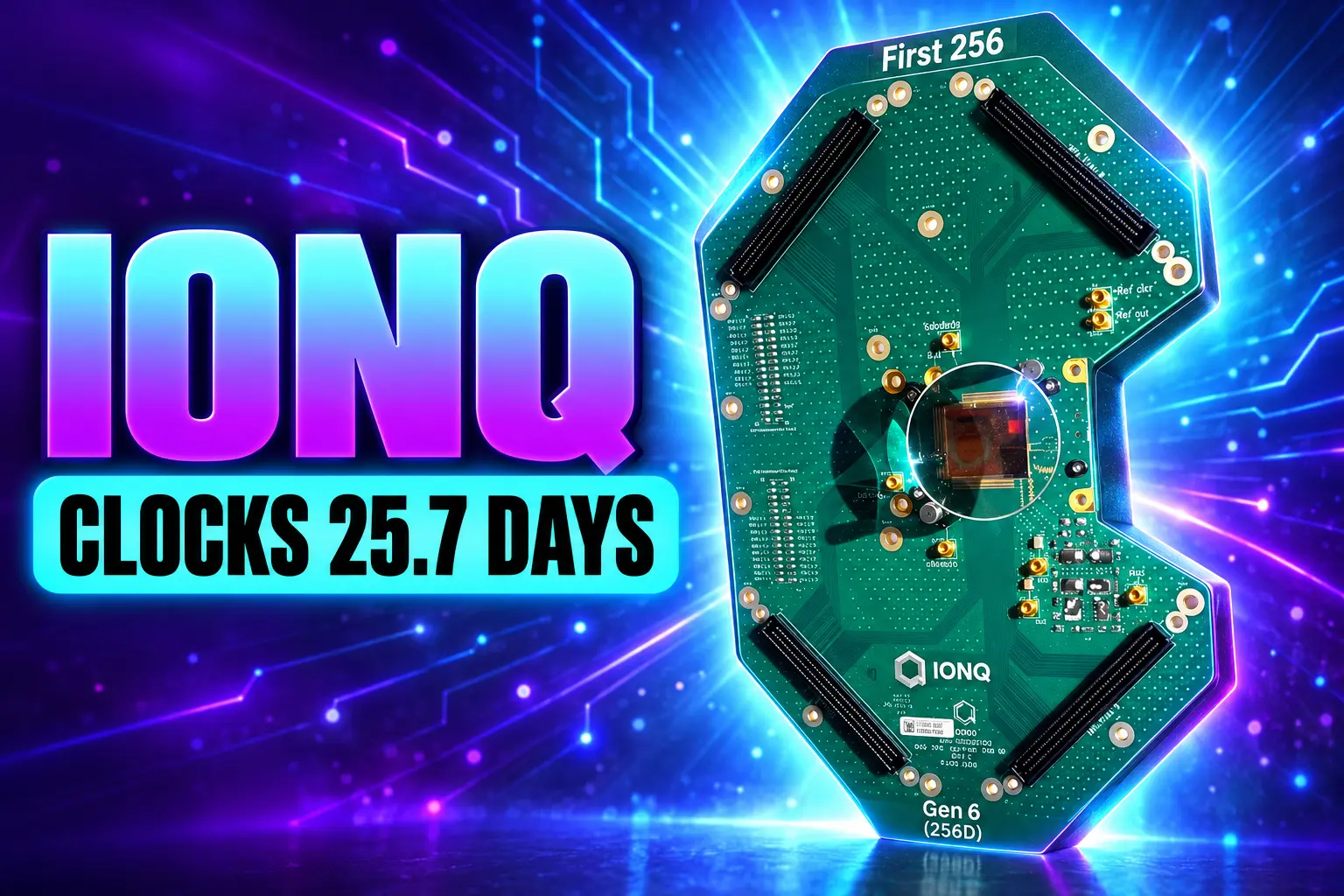
The machine IonQ wants people to order while they digest that paper is Superion 256, the first product in a sixth-generation line. It is a 256-qubit trapped-ion system with electronics on the chip instead of a laser hall. De Masi said Oxford Ionics made that control scheme possible and SkyWater made the wafers, and he called Superion the first quantum computer platform built by the hundreds rather than one at a time.
IonQ has shipped five generations since 2019, most recently Tempo. Superion is the one it is trying to sell as furniture for a normal data hall: a standard server-rack footprint, no custom buildout, cooling that ties into a typical plant, and a power draw it says is lower than a rack of GPUs. Customer deliveries are slated for 2027, and the company is taking orders now. It also said one 256-qubit system was pre-sold earlier in 2026.
WHAT SUPERION 256 BRINGS TO A DATA HALL
- The wafers: First fully integrated 256-qubit processors were made at SkyWater after six tapeouts in the first half of 2026.
- The cycle: Working with that foundry, IonQ cut its design cycle from nine months to two and delivered 12 times more wafer lots over six months than at a prior foundry.
- The prototypes: First ions are already trapped in systems being built in parallel at several U.S. sites.
- The control: Electronic Qubit Control, the on-chip scheme behind IonQ’s 99.99% two-qubit gate fidelity record in October 2025, runs the gates.
- The next step: Superion 10K, about 10,000 physical qubits with CMOS on the chip, is in development as the first generation built to run Walking Cat.
Ballance put full fault tolerance in an IonQ lab in 2027 and a manufacturable commercial version in 2028. The company expects the shift from lasers to semiconductor control to cut cost per qubit by more than 300 times across the roadmap. In August it reported breakeven error correction with qLDPC codes on a Tempo engineering system, a hardware check on the architecture published in April.
That is the compute half of the Brennan conversation. IonQ posted the product film as Investor Day opened.
Today we debut IonQ Superion 256, our 256 physical qubit system, and IonQ Superion product line. Developed in partnership with SkyWater Technology, it operationalizes our Walking Cat architecture for full fault-tolerant quantum computing, the blueprint for scaling beyond 10,000… pic.twitter.com/ZxpbVaHHsv
— IonQ (@IonQ_Inc) September 8, 2026
A 256-qubit rack is not the 19,397-qubit machine in the paper. IonQ is selling the smaller box now and dating the larger one to the same years it used for the secp256k1 estimate. Buyers are being asked to fund both stories at once.
The $8.18 Million Deal Sells the Other Half
The same morning, IonQ and Congruity360, an unstructured-data firm in Boston, announced an $8.18 million agreement that IonQ called one of the largest commercial quantum-security contracts yet in the United States. IonQ will supply Clavis quantum key distribution pairs and Solteris network appliances. Congruity360 will fold them into its data platform so traffic between sites rides a quantum-safe link.
Shapiro did not hide the policy hook. He tied the deal to the June order that pulled civilian agencies forward and reached contractors.
The White House’s June 2026 executive order pulls federal post-quantum deadlines forward to 2030 and extends them to contractors. Congruity360 is integrating IonQ’s quantum key distribution (QKD) on top of post-quantum cryptography to protect data that must stay confidential long after those deadlines pass.
Jordan Shapiro, President of Quantum Platform, IonQ, September 8 statement
Congruity360’s roster runs through finance, health care and insurance, legal, manufacturing, defense, and universities, the sectors with long retention rules. Brian Davidson, its chief executive, said security has to move faster than most firms are ready for as AI systems get more capable, and he framed the IonQ gear as part of data-security posture, not a lab demo. IonQ already points to a Florida LambdaRail plan, a Switzerland upgrade with Cisco, and a large operational QKD network in Europe as prior installs.
The pairing is tidy. One press packet describes how a future IonQ-class machine could forge elliptic-curve signatures. The next sells boxes meant to protect data in motion with keys that machine is not supposed to steal. Both land in the same cybersecurity chapter de Masi took to Brennan.
The White House Already Moved the Migration Dates
De Masi’s Q-Day line only works because the government moved first. Executive Order 14412, signed June 22, 2026, and titled Securing the Nation Against Advanced Cryptographic Attacks, sets federal post-quantum cryptography deadlines for high-value assets and high-impact systems: post-quantum key establishment by December 31, 2030, and post-quantum digital signatures by December 31, 2031. National security systems stay on a separate NSA track.
The order states the harvest-now problem in plain language. Adversaries can collect encrypted U.S. information now and decrypt it later once large-scale quantum computers work. That is why key exchange moves first. Recorded traffic cannot be un-stolen after the fact. Signatures, which IonQ’s paper actually targets, fail forward: a broken root of trust lets an attacker mint new identities, sign new code, and impersonate devices after the break, which is why those migrations are slow and why an early estimate still matters.
THE CRYPTOGRAPHY CLOCK
- August 13, 2024: NIST publishes FIPS 203, 204, and 205, the first approved post-quantum standards for key encapsulation and signatures.
- April 2026: IonQ publishes the Walking Cat blueprint for a fault-tolerant trapped-ion machine.
- June 22, 2026: The White House signs Executive Order 14412 and names 2030 and 2031 as civilian PQC dates.
- December 31, 2027: NIST is to finish a pilot migration on a subset of its own systems.
- December 31, 2030: High-value and high-impact federal systems must use PQC for key establishment; covered contractors are pulled toward the same year.
- December 31, 2031: Those systems must use PQC for digital signatures.
The replacement math is not theoretical. NIST’s ML-KEM key-encapsulation standard (FIPS 203) is the module-lattice scheme meant to stand in for today’s key exchange, with parameter sets ML-KEM-512, ML-KEM-768, and ML-KEM-1024. FIPS 204 (ML-DSA) and FIPS 205 (SLH-DSA) cover signatures. IonQ said both signature families sit outside the class of attack its secp256k1 study describes. The standards have been on the shelf since 2024. The order is what turned them into a calendar with procurement teeth.
How Quantum Fits Next to GPU-Based AI
Brennan’s rundown listed AI beside cybersecurity, and Superion’s power claim is the part of that pitch that can be checked against a room. IonQ says the box draws less than a GPU rack and cools like other data-center gear. In halls already short on watts, a second kind of accelerator that does not demand a new building is easier to get past facilities than a cryogenic cathedral.
That is still a placement argument, not a training-run benchmark. Superion 256 is a 256-qubit physical machine. IonQ’s own fault-tolerance dates sit in 2027 in the lab and 2028 on a factory line. Drug-design and materials jobs that IonQ cites with Amazon Web Services, AstraZeneca, and NVIDIA were run on earlier systems the company says delivered a 20 times lift over prior quantum tools, which is a quantum-to-quantum comparison. It is not a claim that a 256-qubit rack replaces a GPU cluster for model training.
The commercial path IonQ is pushing is hybrid: keep the GPU farm for the correlation work it already does, and park a quantum box beside it for the chemistry, optimization, and crypto-adjacent jobs that map onto qubits. Cloud access since 2021 is how most customers still meet the hardware, including smaller contracts such as the Archer Materials IonQ cloud deal. A rack that installs behind a corporate firewall is the newer offer, aimed at firms that will not send proprietary structures out to a public endpoint.
De Masi has spent a year telling executives they do not need to design a qubit to buy the outcome, the way they do not need to design a Blackwell GPU. Superion is the prop for that line. The secp256k1 paper is the fear that makes a CISO take the meeting.
SkyWater, Not Qubits, Does Most of the Sales Lift
Investor Day also produced the figure equity desks will quote. IonQ now expects 2026 revenue of $450 million to $460 million. That outlook includes SkyWater from July 31, 2026, the day the $1.8 billion foundry deal closed, through December 31, and it strips out estimated intercompany sales under the old IonQ-SkyWater supply contract. The prior range, set in August and still excluding SkyWater, was $280 million to $290 million. Midpoint to midpoint the step is $170 million.
IONQ’S 2026 SALES MIX
- New range: $450 million to $460 million, first combined guide after SkyWater.
- Old range: $280 million to $290 million, quantum platform only, with 100% organic growth still the internal target.
- Last quarter: $80.1 million in the second quarter, up 287% from $20.7 million a year earlier, and 20% above IonQ’s own plan.
- Cash: $3.0 billion in cash, cash equivalents, and investments at June 30, 2026, before a full year of foundry costs sits on the books.
De Masi said the new guide shows traction in the quantum platform and manufacturing scale from SkyWater. Both can be true at once, and the calendar still says most of the added dollars are the foundry’s. SkyWater is how IonQ wants to make Superion a product line instead of a science project. It is also how a quantum company prints a 2026 sales number that looks like a mid-size chip vendor.
Shares closed September 8 at $40.47, up 2.40% on the session, inside a day range of $39.45 to $44.43. The 52-week range is $25.89 to $84.64, and the equity was valued around $16 billion on publicly traded shares. That close is 52% below the 52-week high. The paper, the rack, and the QKD contract are being asked to carry a stock that already baked in a lot of future qubits.
What the Paper Breaks and What It Leaves Standing
IonQ was explicit about the failure mode. The exposure is authentication and integrity, not confidentiality. Elliptic-curve signatures sit under code signing, certificate hierarchies, device identity, and other long-lived roots of trust. A break there is useful after the machine exists. It does not unwind traffic an adversary stored last year. Harvest-now-decrypt-later still belongs to RSA and elliptic-curve key exchange, which is why the White House put key establishment a year ahead of signatures.
John Gamble, vice president of architecture, said the hardware count sits at the same scale as systems IonQ is already building toward, and that fault-tolerant computing looks like an engineering problem with a path rather than a distant abstraction. Shapiro added that the algorithms meant to replace elliptic-curve signatures need the same stress tests, and that IonQ intends to keep running them. ML-DSA and SLH-DSA, he noted, are not touched by this class of result. Roots of trust are the last things enterprises swap, which is why a dated estimate is useful even if the 19,397-qubit box is still a 2028-class drawing.
WHAT WE KNOW
- The count: IonQ’s compiled estimate is 19,397 physical qubits and 25.7 days per attempt on secp256k1.
- The product: Superion 256 is on sale now for 2027 delivery as a data-center rack, not as that 19,397-qubit machine.
- The counter: NIST’s 2024 PQC standards are approved, and IonQ is already billing QKD plus PQC as a stack, starting with the Congruity360 contract.
WHAT IS UNCONFIRMED
- Q-Day itself: No public machine has run Shor’s algorithm against a live 256-bit curve; IonQ’s 2027 lab and 2028 factory dates remain company targets.
- The sales mix: How much of the $450 million to $460 million range is quantum computers versus SkyWater wafers will only show up in later segment reporting.
- The Brennan tape: The September 9 interview has no published transcript, so claims about wording on that set stop at the topics the show listed.
Certificate teams inside banks, software vendors, and device makers do not get to wait for Superion 10K to ship before they inventory roots of trust. The 25.7-day figure is an estimate on a machine that does not exist yet. The certificates it names are already in production.
Disclaimer: This article is news reporting and analysis of company statements, a technical resource estimate, and public policy, and it is for information only. It is not investment advice, a recommendation to buy or sell IonQ or any other security, or a forecast of Q-Day, Superion deliveries, or 2026 revenue. Readers who are considering any financial decision should consult a licensed financial adviser who can review their own holdings, time horizon, and risk tolerance. Figures, product dates, and policy deadlines here reflect the company releases, the White House order, and NIST standards as of the article’s date and may change as later filings, hardware results, or rules arrive.

Nesta Finds a Baby Blind Spot in Scotland’s GIRFEC Promise

FDA Closes Cyclospora Lettuce Probe Without Proving How

Pixel Watch 5 Discount Erases Google’s $50 Launch Hike

Pokémon GO Halloween 2026 Locks Candy Behind a Pass

ARX Robotics and Roboneers Tie Ukraine Combat to Western Fleets

Where Can I Cash a Comcheck – What Are My Options?

Arm Bets Compute Subsystems Will Reach Physical AI

The Yen Rally Was Funded by a Record Reserve Sale

OpenAI Turns ChatGPT Into a $1 Billion Ad Auction

Coremail Pitches AI-Native Email Security at LEAP 2026
-
 LIFESTYLE3 years ago
Where Can I Cash a Comcheck – What Are My Options?
-
 BUSINESS1 month ago
The Yen Rally Was Funded by a Record Reserve Sale
-
 NEWS1 month ago
Arm Bets Compute Subsystems Will Reach Physical AI
-
 BUSINESS2 months ago
OpenAI Turns ChatGPT Into a $1 Billion Ad Auction
-
 NEWS1 month ago
Coremail Pitches AI-Native Email Security at LEAP 2026
-

 NEWS1 month ago
Gottheimer’s AI LABS Act Enters an Already Crowded Field
-

 TECHNOLOGY3 years ago
How Many Cards in a Uno Deck – What’s the Exact Number?
-

 BUSINESS1 month ago
Ostrich Farms Rebuild Around a Tick-Bite Meat Allergy