
NEWS
The Agentic AI Speedup in Pharma Stops at Sign-Off
Agentic AI can shrink pharma discovery and drafting to hours, but FDA credibility rules and human sign-off still sit on every safety-critical output.

The FDA’s first AI guidance for drug decisions is still a draft, while labs now sell agents that finish weeks of discovery work in hours. That gap is the live story in agentic AI for biopharma, not the slide that says the whole value chain has already changed.
On September 2, 2026, Owkin licensed its K Pro “AI Scientist” to Boehringer Ingelheim for oncology and immunology. The pitch is speed over patient data. The fine print is that the same system is built for human-led analysis as much as for campaigns that run on their own.
The 80 Percent That Never Hit the P&L
McKinsey’s Life Sciences practice and QuantumBlack analyzed 270 workflows and 1,200 tasks across 180 job families in a September 8, 2025 study. The firm’s own setup is blunt. Nearly eight in ten companies already use generative AI, yet 80 percent of those users report no tangible bottom-line benefit, a stall it calls the AI paradox.
Agentic systems are the proposed way out: goal-driven software that breaks work into steps, calls other tools, and keeps a memory. The same paper says life sciences is too tightly ruled for that loop to run unsupervised. Agents must consult humans before important decisions or major tasks. Guardrails sit with the firm, the function, or the supervisor who owns the agent.
The upside McKinsey modeled is large, and it is modeled, not booked. In pharma, 75 to 85 percent of workflows contain tasks that could be enhanced or automated, which could free 25 to 40 percent of capacity at the task level, meaning slices of people’s weeks rather than whole headcount. Up to 95 percent of roles may end up with an agent as a teammate. About 40 percent of workflows include work that is too complex or too costly for people to do now, which is where the firm thinks new output, not just faster old output, would appear.
MCKINSEY’S MODELED AGENTIC LIFT
| Measure | Pharma | Medtech |
|---|---|---|
| Workflows with tasks agents could enhance or automate | 75 to 85% | 70 to 80% |
| Incremental growth | 5 to 13 percentage points | 3 to 7 percentage points |
| EBITDA over three to five years | 3.4 to 5.4 percentage points | 2.2 to 4.7 percentage points |
Half of the pharma gain, in that model, would come from net revenue (more assets, more patients, shorter time to market) and half from leaner research, plants, and admin. The study also names ten new jobs, including agent orchestrator, AI quality manager, and agent supervisor. Freed time, it says, can be reinvested, frozen as hiring, or taken as margin. That choice is the part the productivity charts skip.
How a qPCR Assay Went From Months to Two Hours
The timed proof points sit in early discovery, where the work is literature, protocols, and in-silico ranking, not a filed drug. A 2026 paper in Drug Discovery Today by Dinh Long Huynh, Srijit Seal, and the AI Agents for Science consortium collected operating systems from startups in the United States, the United Kingdom, and Sweden. Seal, a visiting scientist at the Broad Institute of MIT and Harvard, described the architecture as large language models wired to tools, memory, and data so the loop can think, act, observe, and reflect.
Agentic AI builds on the recent advancements in LLMs’ reasoning capabilities but couples them with external tools, memory, and data sources, enabling systems that can ‘think’, ‘act’, ‘observe’, and ‘reflect’ in iterative loops.
Srijit Seal, visiting scientist, Broad Institute of MIT and Harvard
Those loops are fast on paper. They are also incomplete until a person runs the experiment and signs the record. Independent write-ups of the same cases note that empirical validation was still required after the agent finished, and that the published scores track whether the agent answered, not whether the reasoning was sound.
THE DISCOVERY CASES ALREADY TIMED
- Kiin Bio, London: A multi-agent “Virtual Scientists” stack ran an idiopathic pulmonary fibrosis program, literature through ranked small-molecule hits, in under two hours against a usual two to three weeks.
- Happy Potato’s Tater: The Seattle firm’s agent cut qPCR assay design from one to four months to under two hours, a greater than 400-fold drop, and emitted Opentrons robot code with a MIQE-aligned protocol.
- Human Chemical: A ReAct agent on the fragrance chemical Cashmeran predicted endocrine-disruption risk, ran metabolite predictions, and assembled a literature-backed risk note.
- onepot.ai, South San Francisco: Hardware-linked agents ran small-molecule synthesis at 50 to 88 percent success and tens of compounds a day, shortening the design-make-test loop.
- Augmented Nature: A supervisor plus disease, pathway, protein, compound, and safety agents shortlisted repurposable ligands for spinal muscular atrophy in hours rather than weeks.
Max Jaderberg of Isomorphic Labs put the same idea in a line that has been clipped for more than a year: in five years, doing drug design without AI will be like doing science without maths. He also said you still guide the agents while they search molecular space. The scarce input in that setup is not another planner. It is expert-labeled lab data, the assay metadata and ontology tags that live in scientists’ heads and do not sit in public papers.
Clinical Study Reports in Six Weeks, Not 12
Development, not discovery, eats nearly 70 percent of total R&D spend, McKinsey said in a December 11, 2025 note, and failure rates stay high. Agents here are copilots on start-up, data cleaning, stats code, and writing, with a person still closing the trial. The firm’s high-end sketch is up to twice as many trials on the same resources and trial durations cut by as much as 12 months. Clinical productivity, in a companion readout, sits at 35 to 45 percent after a slice of time is given back to watching the agents, about 7 percent on average across functions.
CLINICAL TIME THE AGENTS ARE SAID TO CUT
- Study start-up: Site picks from performance and demographics, first-time-right contracts, and outreach that can double activation rates with 30 to 50 percent fewer staff.
- Queries and builds: LLM plus heuristic cleaning for two to three times fewer queries; database builds from two to three months to under two weeks; programmer output up to 60 percent higher.
- Study reports: A multi-agent CSR stack with a large pharma client cut drafting errors by 50 percent and moved lock-to-final from around 12 weeks to six.
- Trial design: Similar-trial benchmarks and a draft protocol in minutes, with a claimed 50 percent faster design and 25 percent fewer amendments.
One large company already runs a multi-agent trial copilot on site activation, enrollment, and data, and plans to let those agents talk directly to investigators and clinical research associates for routine chores. Document agents can also flag related files when one section changes, which is the unglamorous failure mode in a submission pack. None of that retires the medical writer. It moves them from first draft to the pass that a regulator will treat as a person’s work.
The FDA’s AI Guidance Is Still a Draft
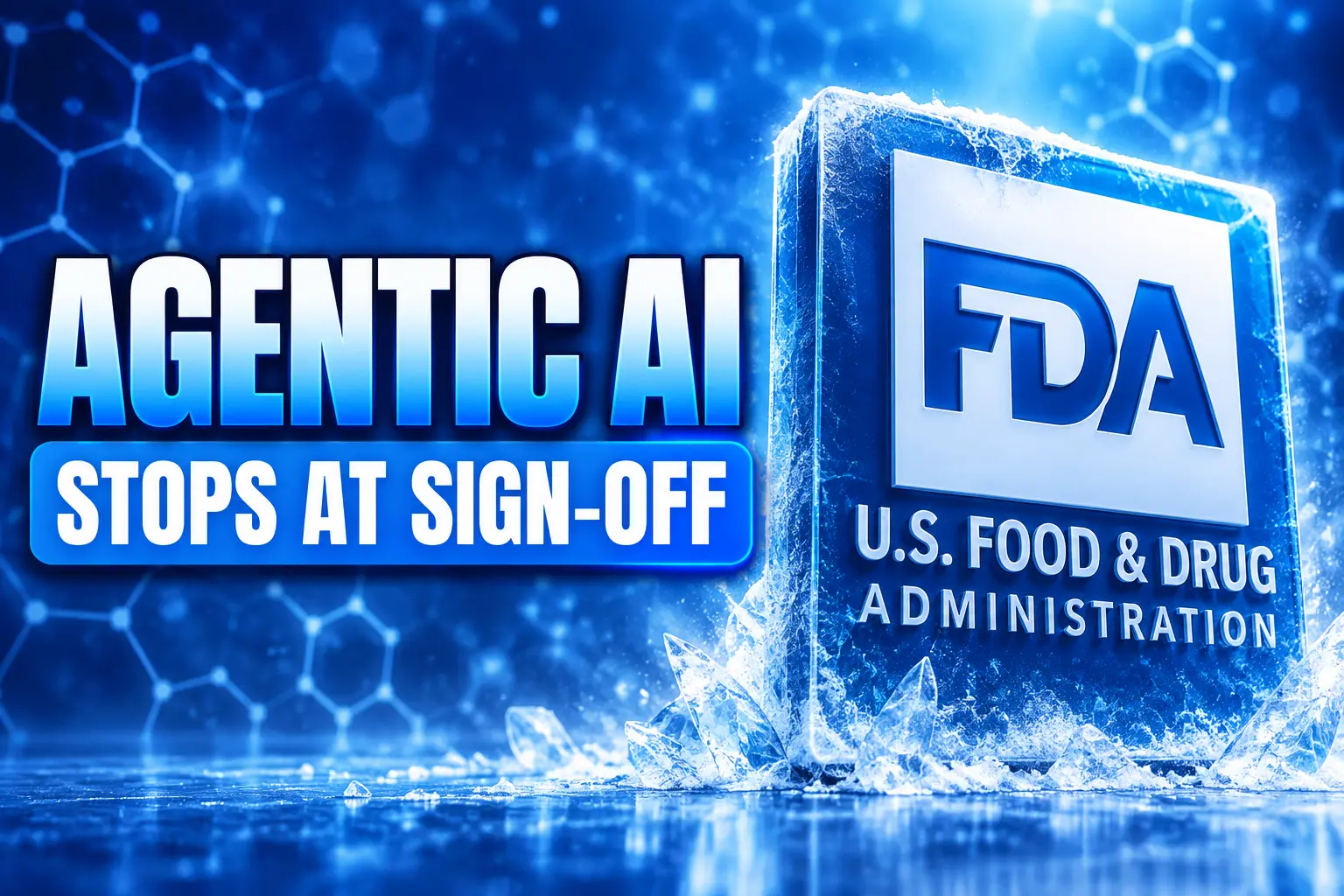
If the lab can emit a protocol in under two hours, the agency still has to believe the model behind it. On January 6, 2025, the FDA issued its first guidance on AI used to support a regulatory decision about a drug or biologic’s safety, effectiveness, or quality. The page still lists it as draft, not for implementation, with non-binding recommendations. The core is a risk-based credibility assessment framework tied to a stated context of use, meaning how the model is applied to a specific question.
The draft grew out of a December 2022 Duke-Margolis workshop, more than 800 comments on May 2023 discussion papers, and more than 500 drug and biologic submissions with AI components since 2016. Comments on the docket closed April 7, 2025. CDER later held hybrid workshops on August 6, 2024 and October 7, 2025. A year after the comment window shut, the file had not been converted into final guidance.
THE REGULATOR’S CLOCK ON AI
- January 6, 2025: FDA publishes the draft AI guidance for drug and biologic decisions and opens a 90-day comment window.
- April 7, 2025: The public comment period on docket FDA-2024-D-4689 ends.
- October 7, 2025: CDER holds a further hybrid workshop on responsible AI in drug and biologic development.
- January 14, 2026: FDA and EMA release a shared set of 10 high-level principles, with “human-centric by design” listed first.
Then-commissioner Robert M. Califf framed the draft as an opening, not a green light for unsupervised filings.
With the appropriate safeguards in place, artificial intelligence has transformative potential to advance clinical research and accelerate medical product development to improve patient care.
Robert M. Califf, M.D., FDA Commissioner, January 6, 2025
On January 14, 2026, CDER and CBER, working with the European Medicines Agency, put out ten principles for good AI practice across the medicines life cycle. The list starts with human-centric design, then risk-based validation, standards, a clear context of use, mixed expertise, data governance, model design, performance checks, life-cycle upkeep, and clear essential information. EMA said the text will underpin later guidance on each side of the Atlantic. It does not replace a finished FDA framework for AI evidence in a filing.
Boehringer’s License Is for Data as Much as Agents
The September 2, 2026 Owkin deal is what a paid rollout looks like while that draft sits. Owkin announced a license agreement with Boehringer Ingelheim covering K Pro plus multimodal patient data for several oncology and immunology indications. Terms were not disclosed. The pact follows a 2025 pilot in which Owkin used its MOSAIC spatial atlas to read the tumor microenvironment around a gene target.
Boehringer teams will query that data inside K Pro, which Owkin describes as one environment for reproducible analysis. Reasoning in the product, the firm said, supports human-led work and self-driven campaigns for hypothesis generation, testing, and ranking. AstraZeneca took a multi-year K Pro license in May 2026. Sanofi signed a five-year K Pro collaboration on June 5, 2026, with Owkin building purpose-built agents to sit beside Sanofi’s own. The pattern is consistent: a drugmaker is buying a steered workspace over private patient data, not an unsupervised scientist.
This agreement between Owkin and Boehringer Ingelheim shows how cutting-edge AI has the potential to enable data-driven pharmaceutical research.
Thomas Clozel, M.D., co-founder and CEO, Owkin
That is a commercial bet on data access. It is also an admission that the agent is only as good as the multimodal records it is allowed to see, which is the same constraint Seal’s paper flagged as data heterogeneity, privacy, and the lack of shared benchmarks.
Thirty Agents Need a Foundry and a Human
McKinsey’s development note says getting value across operations means orchestrating upwards of 30 specialized agents, which in turn needs an enterprise “foundry” to design, train, and run them. Isolated pilots do not add up. The same note’s most revealing product is not a faster CSR. It is a simulated reviewer.
The firm describes a virtual regulator is still in development: a digital twin of health authorities, fed on past filings and feedback, that scores draft text against ICH E3 (clinical study report structure) and ICH E6 (good clinical practice). The twin would flag shaky language, unsupported claims, and structural gaps before a dossier goes out, with a hoped-for cut of up to 40 days in review time and a higher first-cycle approval rate. A second twin would act as a regulatory project manager, sorting reviewer comments by theme for human consensus.
Building a fake FDA because the real one is slow is a tell. The agent can draft. The agency still decides. And the draft credibility file, not the chatbot, is what a sponsor will have to show when the model’s output is used as evidence of safety, effect, or quality.
WHERE A PERSON STILL HAS TO SIGN
- Important actions: McKinsey’s life-sciences rule is that agents consult a person before important decisions or major tasks.
- Context of use: FDA’s draft asks sponsors to state how a model is used for a given question, then match credibility work to that risk.
- Human-centric design: The first FDA-EMA principle is that AI should support expert judgment, not stand in for it.
- Life-cycle drift: The draft flags training-data bias and data drift after deployment, which means a signed model can go stale without a watch plan.
Hallucinations are the sharp edge of that list. An agent that invents a citation in a marketing brief is an embarrassment. An agent that invents a toxicity call, a protocol step, or a deviation narrative is a patient-safety and inspection problem. Human-in-the-loop is not a slogan in that setting. It is the only role the draft guidance and the joint principles currently describe.
Who Signs When the Model Drifts
The hour-scale discovery demos are real, and so is the Boehringer license. So is the unfinished rulebook. A qPCR agent can emit robot code before lunch. A CSR agent can cut lock-to-final from around 12 weeks to six. A sales-side copilot can draft the next call plan. None of those outputs is a marketed medicine, and none of them yet travels with a final FDA method for proving the model was credible in its stated use.
Pharma will keep buying agents anyway, because the alternative is the 80 percent of generative-AI programs that never moved the P&L. The companies that get a return will be the ones that budget for the boring layer McKinsey quietly added to the org chart: orchestrators, quality managers, and supervisors who can explain, in a room with inspectors, why the agent’s last run is still fit for a filing. K Pro will keep offering human-led analysis beside self-driven campaigns. The signature line on the protocol will still have a person’s name.

Nesta Finds a Baby Blind Spot in Scotland’s GIRFEC Promise

FDA Closes Cyclospora Lettuce Probe Without Proving How

Pixel Watch 5 Discount Erases Google’s $50 Launch Hike

Pokémon GO Halloween 2026 Locks Candy Behind a Pass

ARX Robotics and Roboneers Tie Ukraine Combat to Western Fleets

Where Can I Cash a Comcheck – What Are My Options?

Arm Bets Compute Subsystems Will Reach Physical AI

The Yen Rally Was Funded by a Record Reserve Sale

OpenAI Turns ChatGPT Into a $1 Billion Ad Auction

Coremail Pitches AI-Native Email Security at LEAP 2026
-
 LIFESTYLE3 years ago
Where Can I Cash a Comcheck – What Are My Options?
-
 BUSINESS1 month ago
The Yen Rally Was Funded by a Record Reserve Sale
-
 NEWS1 month ago
Arm Bets Compute Subsystems Will Reach Physical AI
-
 BUSINESS2 months ago
OpenAI Turns ChatGPT Into a $1 Billion Ad Auction
-
 NEWS1 month ago
Coremail Pitches AI-Native Email Security at LEAP 2026
-
 NEWS1 month ago
Gottheimer’s AI LABS Act Enters an Already Crowded Field
-

 TECHNOLOGY3 years ago
How Many Cards in a Uno Deck – What’s the Exact Number?
-

 BUSINESS1 month ago
Ostrich Farms Rebuild Around a Tick-Bite Meat Allergy