
AUTO
JSW’s Volkswagen Majority Plan Hinges on a China Hedge
JSW Green Mobility and Skoda Auto signed a non-binding India car MoU, a 51:49 map that hedges China risk while a Rs 11,526 crore duty case hangs over valuation.

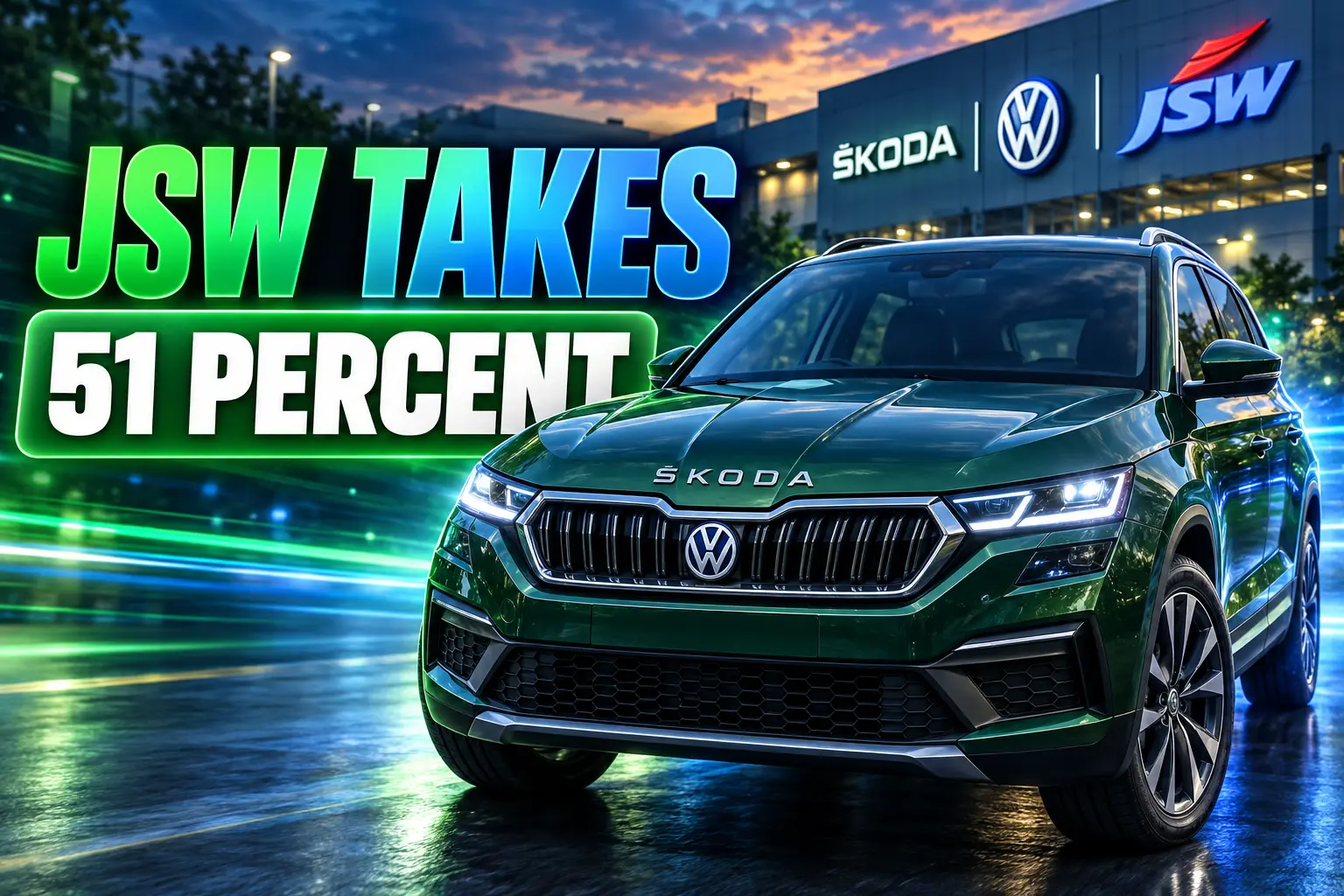
JSW Green Mobility and Skoda Auto a.s. signed a non-binding MoU on 8 September 2026 to study a passenger-car joint venture in India. Official statements do not print a split. People close to the talks say JSW would take 51 percent and Volkswagen 49 percent, with a binding contract aimed at December 2026.
The paper is being sold as a localisation and product deal. It also gives JSW a German car line beside two Chinese ones, and it gives Volkswagen Indian costs it can point at Chinese rivals in Europe.
JSW Green Mobility Put Its Name on the Paper
The signatories are not the full listed groups. JSW Green Mobility Limited, the vehicle through which the conglomerate is building cars and JSW Green Mobility’s wider mobility push, signed with Czech-based Skoda Auto a.s., which already runs Volkswagen Group’s mass-market work in India. Skoda Auto CEO Klaus Zellmer and Volkswagen brand CEO Thomas Schäfer were both in Mumbai as the MoU went down.
A JSW Group spokesperson said, “At this stage, the MoU is exploratory and non-binding. The two companies are in early discussions, and there is no definitive agreement yet.” Any firm arrangement, the same person said, would need more negotiation, internal approvals and regulatory clearances. A Skoda Auto Volkswagen India spokesperson, in a separate official note, described “a two-party partnership structure with joint control, clearly defined roles, and mechanisms designed to support swift and effective decision making.”
Neither note names a shareholding or a cheque size. People familiar with the talks say the economic map is 51:49 for JSW, and that due diligence on Skoda Auto Volkswagen India Private Limited, or SAVWIPL, starts now. Market estimates put project investment and capital commitments at more than €1 billion, about ₹10,000 crore, before anyone has closed a valuation.
THE MOU ON PAPER
- The parties: JSW Green Mobility Limited and Skoda Auto a.s., not the MG venture and not Audi.
- The scope: Develop, make and sell passenger cars for India and for export across petrol, electric, plug-in hybrid and hybrid powertrains.
- The clock: Exclusive talks on valuation and terms, with a binding contract targeted for December 2026.
- The silence: Official statements still omit the 51:49 split that people close to the process treat as the working map.
The new company is being sketched as a JSW Green Mobility subsidiary, sitting beside JSW Motors rather than inside the MG business, so three car lines would stay legally apart if the deal closes.
A German Car Bet Beside Two Chinese Ones
JSW already holds 35 percent of JSW MG Motor India with SAIC, the Chinese state group that keeps 49 percent. The rest sits with Indian institutions, dealers and employees. A separate JSW Motors line sources models from Chery’s Chinese catalogue. A closed Skoda pact would be the first JSW car partnership with no Chinese shareholder, a point that matters after Beijing’s tech-transfer limits forced the group to pause a planned 50 GWh lithium-ion cell plant.
Two executives described the industrial logic in the other direction. Volkswagen has brand recall after two decades in India and still needs a local partner to cut cost. Cars built in Maharashtra, on this telling, could move to Europe under the India-European Union trade agreement signed in 2026, using Indian costs against Chinese manufacturers in that market. Audi, Porsche, Lamborghini and Bentley are expected to stay outside the first perimeter. The partners would jointly name the chief executive and the chief financial officer.
This is one of the more strategically coherent JSW automotive bets. Unlike the Chery-linked JSW Motors venture, this one carries no China exposure. That matters, given the current geopolitical and investment-screening climate around Chinese capital in Indian manufacturing.
Vinay Piparsania, founder, MillenStrat Advisory and Research
The irony is structural, not rhetorical. JSW would be the majority Indian partner in a German volume-car company while remaining the smaller partner in a Chinese one, and Volkswagen would be asking that Indian factory to fight the same Chinese industry JSW already works with. The three lines are meant to stay separate. Dealers, suppliers and future EV platforms will test how separate that is in practice.
159,500 Cars Went Through 400,000 of Capacity
SAVWIPL’s Maharashtra plants at Chakan and Chhatrapati Sambhajinagar can stamp 400,000 vehicles a year. In calendar 2025, a record year, the group sold 159,500 vehicles including exports, of which 117,000 were domestic, up 36 percent. That is the gap the MoU is supposed to close. Volkswagen Group’s own tally recorded 70,600 Skoda vehicles delivered in India in 2025, up 96.1 percent, after the sub-4-metre Kylaq SUV took more than 45,000 units.
OUTPUT AGAINST THE NAMEPLATE
| Measure | Number | Context |
|---|---|---|
| Annual plant capacity | 400,000 vehicles | Chakan and Chhatrapati Sambhajinagar |
| 2025 sales including exports | 159,500 | Well short of nameplate |
| 2025 domestic sales | 117,000 | Record year, up 36 percent |
| 2025 Skoda deliveries in India | 70,600 | Up 96.1 percent, Volkswagen Group |
India 2.0, launched in FY19, set a 5 percent passenger-vehicle share by 2025. Society of Indian Automobile Manufacturers figures put the group at 2.44 percent in FY26, about half that goal, even after the Kylaq revival. In FY26 Skoda sold 75,556 cars, up 68 percent, while Volkswagen-branded cars fell 11 percent to 37,576. Ministry of Corporate Affairs filings dated 24 July show SAVWIPL net profit of ₹139 crore in FY26, up 48 percent, on revenue of ₹22,338 crore. The parent still more than doubled financial support to ₹1,341 crore, including ₹969 crore from Skoda Auto a.s.
Cumulative production in India has crossed 2 million vehicles, and cumulative exports have crossed 715,000. Those are real plants with a real supplier base. They are also plants that, in the best year on the books, still ran far below the 400,000 figure on the gate. People close to a three-year cost programme that began in 2025 have described a cut of about 12 percent of staff, a few hundred white-collar and shop-floor roles, through 2027. Piyush Arora, managing director and chief executive of SAVWIPL, said, “While we do not comment on speculative figures regarding our workforce, our ongoing efforts to optimise operations across our Indian business units continue to gain momentum.”
Who Carries the ₹11,526 Crore Duty Case
Valuation talks now have to price a live customs fight. In September 2024, Indian customs issued a show-cause notice alleging that SAVWIPL classified imports for Audi, Skoda and Volkswagen cars at the Chhatrapati Sambhajinagar plant as loose parts rather than completely knocked-down kits. The demand in Skoda Auto Volkswagen India Pvt Ltd v. Union of India is ₹11,526 crore ($1.4 billion). The notice covers about 33,000 transactions from March 2012 to July 2024. The company disputes the claim and says the notice is time-barred.
Under India’s duty ladder, a fully built imported car can face levies of around 70 percent and, for costlier cars, 100 percent or more. A CKD kit with the engine, gearbox and transmission not pre-assembled is charged 15 percent. A kit with a pre-assembled engine or gearbox is charged 30 percent. Loose components sit lower still. That gap is the whole case. SAVWIPL has argued that it imported parts in line with a 2011 revenue clarification. Customs has argued the other way.
THE DUTY FILE IN COURT
- March 2012 to July 2024: Imports at the then Aurangabad plant sit inside the show-cause notice.
- September 2024: Customs issues the ₹11,526 crore demand, with interest, and flags about 33,000 transactions.
- 28 April 2025: A Bombay High Court bench of Justices B.P. Colabawalla and Firdosh Pooniwalla reserves judgment, limited at that stage to whether the notice was out of time.
- 25 August 2026: The same bench releases the case without a verdict, citing workload and Supreme Court timelines, and sends it to a fresh bench, with status quo for four weeks.
How that contingent liability is ring-fenced, indemnified or deducted will move the equity cheque as much as any multiple on 117,000 cars. JSW is not buying a clean factory. It is buying a factory plus a file that just went back to the starting line.
Two Earlier Indian Partners Never Reached a Signing
Skoda Auto has been in India since 2001. Volkswagen Group has spent more than two decades building the Maharashtra footprint, the MQB-A0-IN architecture and a network that SAVWIPL put at about 700 customer touchpoints. Partner hunts have failed before. Talks with Tata Motors in 2017 and with Mahindra & Mahindra in 2024 both fell away. Zellmer has said the group was open to ceding majority control to a local partner. JSW is the name that made it to a signed MoU.
That history is why the 51 percent figure, even unofficial, is the point of the paper. Volkswagen is not writing an exit. It is writing a smaller cheque and keeping the brands, the platforms and a joint-control clause. JSW, unlike Tata then or Mahindra last year, already runs car plants, a steel and energy balance sheet, and a political willingness to put capital into Maharashtra manufacturing. It also already has a Chinese car partner, which Tata and Mahindra did not bring into the room in the same way.
Joint Control Is the Phrase Volkswagen Wants
The leaked split and the official language are doing different jobs. People close to the talks talk about JSW’s majority economic interest. Skoda’s public line is joint control and fast decisions. Those can coexist on a term sheet. They can also collide the first time a board has to pick an EV architecture, a dealer plan, or a write-down on the duty case.
Deep localisation and platform synergies are intended to support competitive product offerings, increased scale, and improved profitability in the Indian market.
Skoda Auto Volkswagen India spokesperson, official statement
Product talk around the MoU is still unofficial. Autocar Professional has been told JSW money could fund cars on Volkswagen’s proposed India Main Platform, an EV architecture derived from the China Main Platform and adapted for Indian rules and suppliers. Localisation of a next Kodiaq-class three-row SUV, possibly at JSW Motors’ Sambhaji Nagar plant, has been examined and has not been confirmed. Until a binding contract lists platforms, none of that is a launch plan.
Exports are in the signed scope. So are petrol cars, which means this is not an EV-only sideline. SAVWIPL’s annual return filed for FY 2025-26 will be one of the documents the diligence teams actually open. The workforce, the supplier book and the two Maharashtra plants are expected to sit inside the new company if talks hold. Luxury brands are expected to stay with Volkswagen Group’s own India structure, a perimeter JSW has said it is open to widening later and Volkswagen has wanted eventually to fold in.
Binding Terms Still Have to Price the Plants
December 2026 is a target the two sides have given themselves, not a closing date. Volkswagen is expected to take a firm proposal to its board around that month once valuation and structure are set. Competition clearance, foreign-investment rules and whatever treatment the Bombay High Court file receives will sit after a signature, not before the MoU.
WHAT WE KNOW
- The signature: A non-binding MoU dated to 8 September 2026 between JSW Green Mobility and Skoda Auto a.s.
- The public design: Joint control, ICE plus hybrid plus EV, India sales and exports, separate from the MG venture.
- The court number: ₹11,526 crore remains the demand in the customs petition, now before a new bench.
WHAT IS UNCONFIRMED
- The split: 51:49 is the working leak, not a figure in either official statement.
- The cheque: The more-than-€1 billion estimate is a market figure, not a disclosed transaction value.
- The platforms: India Main Platform cars, a local three-row SUV and Europe-bound EVs have no official timeline.
Due diligence is expected to begin shortly. Both sides have given themselves until December 2026 to put a binding contract on the table, with the duty file, the empty bays and JSW’s other car partners still sitting in the same room.

Gottheimer’s AI LABS Act Enters an Already Crowded Field

JSW’s Volkswagen Majority Plan Hinges on a China Hedge

IonQ Prices a 25.7-Day Break of Bitcoin’s Curve

The Yen Rally Was Funded by a Record Reserve Sale

Coremail Pitches AI-Native Email Security at LEAP 2026
The Yen Rally Was Funded by a Record Reserve Sale

How Many Cards in a Uno Deck – What’s the Exact Number?

OpenAI Turns ChatGPT Into a $1 Billion Ad Auction

Where Can I Cash a Comcheck – What Are My Options?

Things to Do with a Teenager Near Me – What Are Some Fun Ideas?
-
 BUSINESS3 weeks ago
The Yen Rally Was Funded by a Record Reserve Sale
-
 LIFESTYLE3 years ago
Where Can I Cash a Comcheck – What Are My Options?
-
 LIFESTYLE3 years ago
Things to Do with a Teenager Near Me – What Are Some Fun Ideas?
-
 BUSINESS4 weeks ago
OpenAI Turns ChatGPT Into a $1 Billion Ad Auction
-
 TECHNOLOGY3 years ago
How Many Cards in a Uno Deck – What’s the Exact Number?
-

 BUSINESS3 weeks ago
Ostrich Farms Rebuild Around a Tick-Bite Meat Allergy
-
 NEWS3 weeks ago
Coremail Pitches AI-Native Email Security at LEAP 2026
-

 LIFESTYLE3 years ago
What Is the Setting of a Story? Elements of Literary Settings